
This post may contain affiliate links. If you purchase through one of these links, Life Made Simple may earn a small commission at no additional cost to you. As an Amazon Associate, I earn from qualifying purchases.
GLP-1 medications have changed the conversation around weight management.
And understandably, most of that conversation focuses on one thing:
Eating less.
Less hunger. Smaller portions. Fewer cravings. Getting full faster.
But there’s another side of reduced appetite that deserves a lot more attention.
When you eat considerably less food, you have fewer opportunities to give your body what it needs.
Suddenly, the meal you skipped because you weren’t hungry wasn’t just calories you didn’t eat. It may also have been protein, fiber, fluids and micronutrients you didn’t get.
And if this happens repeatedly, “I’m finally not thinking about food all day” can quietly become “Wait…have I actually taken very good care of myself today?”
That distinction matters.
Current expert guidance on GLP-1 therapy increasingly emphasizes nutrition quality, adequate protein, physical activity, strength training, sleep and management of gastrointestinal side effects alongside medication. Reduced food intake can make adequate nutrition more challenging, particularly when it is combined with nausea, constipation or changing food preferences.
So perhaps the most useful question isn’t:
How little can I eat now that I’m taking a GLP-1?
It’s:
How can I make the food, fluids and movement I do get count?
Think “Nutrition Real Estate,” Not Just Calories
Imagine that before starting a GLP-1, you comfortably ate three meals and a snack.
That’s four opportunities every day to get protein, fiber, vegetables, fruit and other nutrients.
Now perhaps you’re comfortable eating two small meals and occasionally something in between.
Your nutritional real estate just got considerably smaller.
That doesn’t mean every bite needs to become a perfectly engineered superfood. It does mean that what earns space on the plate matters a little more when the plate itself has gotten smaller.
This is one reason protein deserves attention during GLP-1-supported weight loss. Recent clinical guidance emphasizes adequate protein intake along with resistance exercise as important strategies for supporting lean mass and physical function during significant weight reduction.
But here’s where I think common GLP-1 advice sometimes goes sideways.
It turns protein into another number to chase.
Instead, try thinking about sequence.
If you’re getting full quickly, which part of the meal do you want to discover you’re too full to finish?
Probably not the protein.
That makes eating your protein-rich food earlier in the meal a practical strategy when appetite is limited. Recent lifestyle-medicine guidance has similarly discussed prioritizing protein earlier in the day when food interest is low.
Make the easiest choice the visible choice
This is where a little kitchen infrastructure can actually earn its keep.
Keep easy protein options where you can see them. Portion foods into small containers rather than giant meal-prep tubs. If shakes work for you, keep your shaker bottle where you’ll actually use it instead of buried behind the Christmas cookie cutters.
Stop Waiting for Thirst to Run the Hydration Department
Reduced appetite can change more than eating.
Sometimes when your normal eating routine changes, the little behaviors attached to it change too.
Maybe you used to refill your drink when you made lunch.
Maybe breakfast came with coffee and water.
Maybe afternoon snacking was also when you remembered to grab another drink.
Remove the old routine and you can accidentally remove some of your hydration cues with it.
That makes hydration less of a thirst problem and more of an environment-design problem.
Instead of relying entirely on “I’ll drink when I remember,” attach drinking to things that still happen every day:
Morning medication → drink.
Get in the car → bring water.
Lunch → refill.
Afternoon break → drink.
Evening routine → check where you are.
If seeing your progress helps, this is one of the rare situations where the gigantic emotional-support insulated water bottle may actually have a job. 😂
The important part isn’t owning a particular bottle. It’s creating a system that makes drinking easier to remember.
And hydration deserves more attention when gastrointestinal symptoms are involved. Expert guidance specifically identifies management of GI effects and adequate nutrition and fluids as important parts of GLP-1 care.
Your Scale Can’t Tell You Whether You’re Getting Stronger
This may be the biggest mindset shift of the entire article.
A bathroom scale measures mass.
It does not measure:
How easily you get out of a chair.
Whether carrying groceries feels easier.
Whether you’re lifting more than you could three months ago.
Whether stairs have become less intimidating.
Whether your balance has improved.
Whether you can get down on the floor and, crucially, return from the floor without drafting a legal will.
Those are measures of function.
And current research is increasingly making an important distinction between changes in measured lean mass and actual skeletal-muscle function. Researchers have cautioned that measurements such as DXA lean mass and BIA fat-free mass aren’t identical to skeletal muscle, and a change in lean tissue doesn’t automatically tell us what happened to strength or physical performance.
That’s fascinating because it gives us a much better goal than simply becoming smaller.
Ask: “What can my body do now?”
Choose a few functional markers that matter in your real life.
Can you:
- Carry groceries farther?
- Stand from a chair more easily?
- Walk longer without tiring?
- Use heavier resistance?
- Climb stairs more comfortably?
That gives you another kind of progress report when the scale decides to spend three weeks staring at you with the same number.
And resistance exercise matters here. Current guidance consistently pairs adequate nutrition, particularly protein, with resistance training when discussing preservation of muscle and function during GLP-1-supported weight loss.
You don’t necessarily need a home gym. A basic resistance-band set takes very little room and can make simple strength work easier to fit into daily life.
The Best GLP-1 Meal May Be the One With the Least Friction
Here’s another thing I don’t think gets discussed enough:
Low appetite changes the economics of effort.
When you’re hungry, making food sounds worthwhile.
When you’re not particularly interested in food, washing vegetables, chopping six ingredients, cooking chicken, assembling a bowl and cleaning the kitchen afterward can suddenly sound like an unreasonable proposal from management.
So the question becomes:
What will I actually eat when eating feels like work?
That’s why I’d create what I call a Low-Effort Food List.
Not a diet.
Not a meal plan.
Not “good foods” and “bad foods.”
Just foods you personally tolerate and can prepare with very little friction.
For example:
Greek yogurt.
Cottage cheese.
Hard-boiled eggs.
Rotisserie chicken.
Soup.
Pre-cut vegetables.
Fruit.
Beans.
Frozen vegetables.
A simple protein shake.
Whatever works for you and fits the recommendations of your healthcare team.
Recent clinical discussion around GLP-1 nutrition similarly emphasizes nutrient-dense foods and practical strategies for getting adequate nutrition when appetite is reduced.
Create an “I don’t feel like eating” shelf
This is one of my favorite practical ideas for this article.
Give one refrigerator shelf or clear refrigerator bin a specific job:
Foods I can eat when nothing sounds good.
Now you’re not standing in front of an open refrigerator conducting negotiations with twelve condiments.
You already made the decision.
Track the Bottlenecks, Not Just the Pounds
Most weight-loss tracking asks:
What did I weigh?
I think a better weekly GLP-1 question is:
What was hardest to do this week?
Maybe it was protein.
Maybe it was drinking enough.
Maybe constipation made eating uncomfortable.
Maybe you were exhausted.
Maybe your appetite was so low that meals kept disappearing from the day.
Maybe you were doing beautifully with nutrition but strength training somehow migrated to the mythical land of “I’ll start Monday.”
Those answers are useful because they identify the bottleneck.
You don’t need to overhaul seven habits when one is causing most of the trouble.
This week:
“I’m barely drinking anything.”
Great. That’s the problem we’re solving.
Next week:
“Water is fine, but I’m realizing I’m hardly getting protein.”
Now that’s the problem.
This turns health behavior into troubleshooting instead of self-judgment.
And it gives us a perfect transition into the free resource we just created.
Download the Free GLP-1 Success Cheat Sheet
You don’t need another complicated health tracker.
I created the Life Made Simple GLP-1 Success Cheat Sheet as a simple two-page guide to help you keep an eye on the daily habits that can be easy to overlook when appetite changes.
It includes:
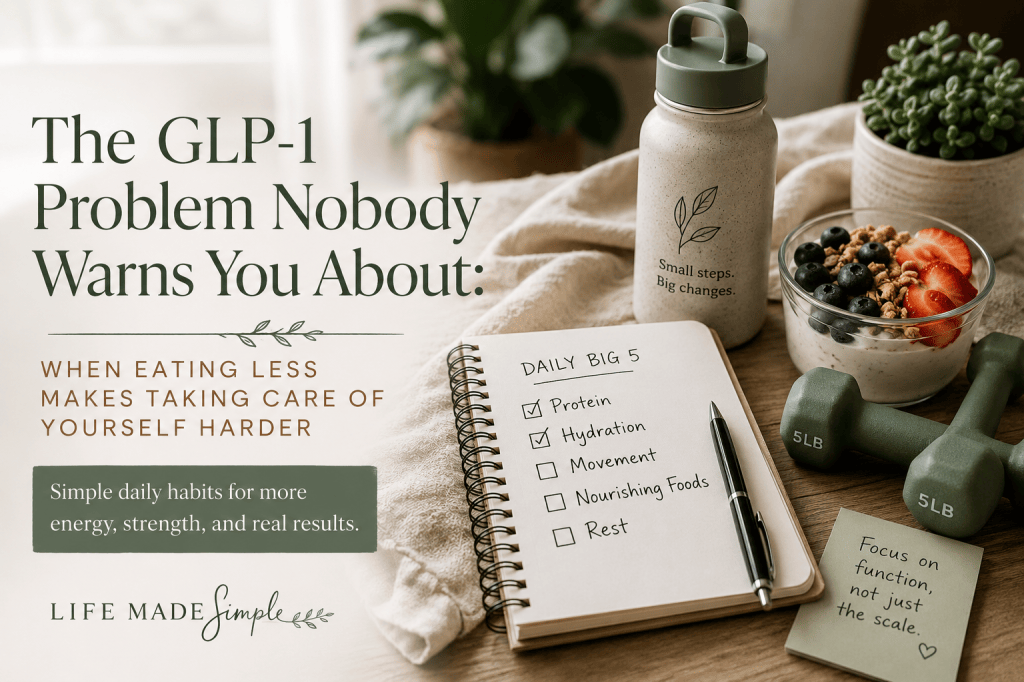
- The Daily Big 5
- Simple protein guidance
- Muscle-support habits
- Hunger and fullness check-ins
- Practical strategies for common side effects
- A weekly progress check-in
- Non-scale ways to notice progress
- Space for questions for your healthcare provider
Get the Free GLP-1 Success Cheat Sheet →
Your Goal Isn’t Just to Become a Smaller Version of Yourself
This is the part I hope you remember.
A GLP-1 can change appetite.
It can make portions smaller.
It can make food quieter.
But eating less isn’t the entire goal.
You still have a body to nourish.
Muscles you want to use.
A life you want enough energy and strength to participate in.
So instead of asking only:
“Am I losing weight?”
Try adding a few better questions:
Am I nourishing myself well with the appetite I have?
Am I getting stronger or maintaining my strength?
Am I staying hydrated?
Am I paying attention when my body tells me something isn’t working?
Am I building habits I could actually live with?
Because the most interesting outcome isn’t simply taking up less space.
It’s being able to do more with the life inside it.
This article is for general educational purposes only and is not medical advice. GLP-1 medications have benefits, risks, contraindications and potential side effects that vary by individual. Nutrition, hydration and exercise needs also vary. Always follow the recommendations of your prescribing healthcare provider and contact your healthcare team about persistent or significant symptoms, difficulty maintaining adequate nutrition or hydration, or other changes in your health.
 Life Made Simple
Leave a comment