
Disclosure: This post contains Amazon affiliate links. If you purchase through one of these links, I may earn a small commission at no additional cost to you. As an Amazon Associate I earn from qualifying purchases.
Protein is easy to recommend when you’re not the one staring at two eggs as if somebody served you an entire Thanksgiving turkey.
I have a confession to make. I’m a certified keto coach. I understand why protein matters. And lately, I’ve eaten more Quest bars and Quest chips than actual meals. Some days I’ll have cottage cheese or Greek yogurt. I’ve been putting collagen in my morning coffee and giving myself credit for trying.
Do I know better? Yes. That’s the point.
Knowing you need protein and being able to eat it are two different things when you’re taking a GLP-1. Your appetite is low. You get full fast. Meat may suddenly sound awful. Then somebody tells you to eat 100 grams of protein as if that’s as simple as taking a vitamin.
It isn’t. So let’s talk about what’s actually doable.
Why is eating protein so hard on a GLP-1?
These medications reduce appetite. Some also slow the rate at which food leaves the stomach. Nausea, constipation, vomiting, reflux and stomach discomfort are common side effects listed in the prescribing information for drugs such as Wegovy and Zepbound.
When you’re eating far less food, it’s easy to come up short on protein without realizing it. The same goes for fluids, fiber, vitamins and minerals.
Protein matters during weight loss because the weight we lose isn’t all body fat. Body-composition studies in GLP-1 trials show that some of it is lean mass. Lean mass and muscle aren’t exactly the same thing, but keeping muscle and strength is still important, especially as we get older.
Eating adequate protein helps. Strength training matters too. Protein gives your body the raw material. Using your muscles gives it a reason to keep them.
How much protein do you need on a GLP-1?
This is where the internet gets bossy.
A 2025 joint clinical advisory on nutrition and GLP-1 therapy discusses a proposed target of 1.2 to 1.6 grams of protein per kilogram of body weight per day during active weight loss. It also suggests that a plain-language target of 80 to 120 grams a day may be easier for some people to use.
That does not mean every person on a GLP-1 must eat 120 grams.
Using current body weight can produce a very high number for someone in a larger body. A clinician or dietitian may calculate from goal weight, ideal weight or adjusted weight instead. Your age, activity level, rate of weight loss and medical history all change the answer.
If you have kidney disease, significant liver disease, a history of an eating disorder or another condition that affects nutrition, get an individual target from your healthcare provider or a registered dietitian.
For everyone else, start by finding out what you eat now. Track two or three ordinary days. Don’t improve the days for the sake of the assignment. If you average 45 grams, work on reaching 60 consistently. Once that feels normal, decide whether you need to go higher.
Sixty grams you actually eat beats a beautiful 110-gram plan abandoned in your Notes app.
Add protein instead of rebuilding your whole life
You don’t have to begin with meal prep, matching glass containers and six pounds of chicken breast. Add 10 or 15 grams to food you can already tolerate.
Some easy additions:
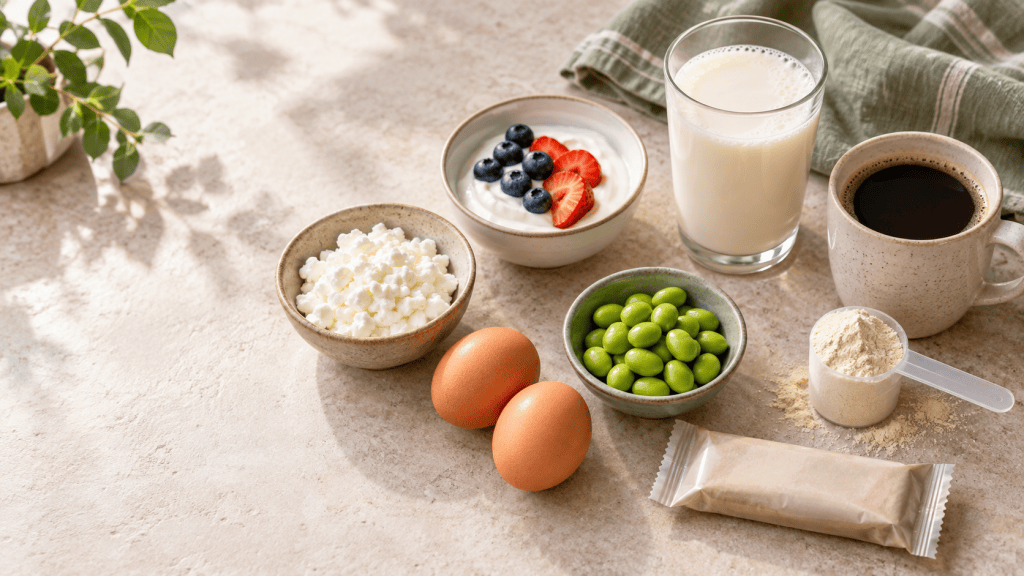
- Two eggs have about 12 grams.
- Half a cup of cottage cheese usually has 12 to 14 grams.
- A cup of regular milk has about 8 grams; ultrafiltered milk often has about 13.
- A cup of soy milk usually has 7 to 9 grams.
- A cheese stick often has 6 to 8 grams.
- Part of a scoop of whey can add 10 to 15 grams without making a full shake.
- A small serving of edamame or tofu can add another 8 to 12 grams.
Labels vary, so check yours. We’re looking for easy places to pick up more protein before your stomach declares the meal over.
Protein foods for a small appetite
| Food | Approximate protein | Why it can help |
|---|---|---|
| Whey isolate, 1 scoop | 20–25 g | A lot of complete protein in a small serving |
| Greek yogurt, 3/4–1 cup | 15–25 g | Cold, soft and easy to portion |
| Cottage cheese, 1/2 cup | 12–14 g | Complete protein that works sweet or savory |
| Ultrafiltered milk, 1 cup | About 13 g | Requires no chewing |
| Soy milk, 1 cup | About 7–9 g | Dairy-free complete protein |
| Two large eggs | About 12 g | Small, inexpensive and easy to change up |
| Tuna or salmon pouch | About 15–20 g | No cooking required |
| Shelled edamame, 1 cup | About 17 g | Savory plant protein with fiber |
| Firm tofu, 3 ounces | About 8–12 g | Mild flavor and easy to use in small portions |
| Protein bar or protein chips | Often 18–21 g | Portable, predictable and easy to track |
These are estimates. Serving sizes and brands can be quite different.
Do protein bars and shakes count?
Yes. They count.
If your bar has 20 grams of protein on the label, it doesn’t disappear because it came in a wrapper. A shake is still protein even though you didn’t cook it.
I wouldn’t build my entire diet out of bars and chips. Trust me, I’ve recently conducted that experiment for all of us. Whole foods bring other things we need, including iron, calcium, zinc, vitamin B12, fiber and healthy fats.
Still, convenience protein can be extremely useful when your choices are a shake or nothing. Use it. Then add variety when you can. Occasionally, I even add some pre-mixed protein shake to my morning iced coffee.
Pay attention to how a product makes you feel. Some bars contain sugar alcohols or added fibers that can cause bloating or make digestive problems worse. Large shakes can also be too filling. Try a different product, reduce the serving or split it into two smaller portions.
Whey, pea protein or collagen?
Whey is a complete dairy protein, meaning it contains all nine essential amino acids. It’s also high in leucine, which helps signal muscle protein synthesis. A scoop usually gives you 20 to 25 grams of protein without much food volume. That’s why I’m switching the collagen in my coffee to unflavored whey.
Soy is a complete plant protein. Pea protein contains all nine essential amino acids, although its proportions and overall protein quality differ from whey and soy. A full serving of pea protein, or a pea-and-rice blend, can be a good dairy-free choice.
There is no evidence that everyone on a GLP-1 needs whey. Use a powder you tolerate, can afford and will drink.
Collagen is the odd one here. It is protein, but it lacks the essential amino acid tryptophan and is low in several other essential amino acids, including leucine. Research on its amino-acid profile classifies it as an incomplete protein.
Collagen may have its own uses. I just wouldn’t use 20 grams of collagen as a replacement for 20 grams of whey, eggs, dairy, soy, meat or fish when I’m trying to protect muscle.
One useful coffee lesson: whey can turn lumpy if you dump it straight into very hot coffee. Mix it into a little cool or room-temperature liquid first, then slowly add the hot coffee. Or you can use my little coffee hack mentioned above.
If you take an oral GLP-1 medication, follow the instructions for when you can eat and drink after taking it. Those directions may be different from an injectable medication.
What if meat suddenly sounds disgusting?
Then don’t make chicken the hill you die on.
Try another texture or type of protein:
- Greek yogurt, cottage cheese, milk, cheese or whey
- Eggs or egg whites
- Tofu, tempeh, edamame or soy milk
- Pea, soy or blended plant-protein powder
- Beans or lentils, if the fiber doesn’t make your fullness or constipation worse
- Tuna, salmon or another fish if that sounds better than meat
- Savory protein foods when you are sick to death of sweet shakes
You don’t have to combine specific plant foods at every meal to create a complete protein. A varied diet across the day can provide the amino acids you need. If you eat entirely plant-based and your total food intake is very low, a dietitian can help you check protein along with iron, vitamin B12, zinc and calcium.
Three days that look more like real life
The totals below are estimates. Adjust the portions for your appetite and your own protein target.
When food sounds fairly normal: about 85 to 95 grams
- Two eggs with half a cup of cottage cheese
- Greek yogurt with berries
- Edamame or a protein bar
- A modest serving of chicken, fish, tofu or tempeh with vegetables
When your appetite is small: about 75 to 90 grams
- Unflavored whey in coffee or a small drink
- Cottage cheese or Greek yogurt
- Protein chips or a bar
- Two eggs, tofu or a tuna pouch for dinner
When it’s the day after your shot and chewing seems unreasonable: about 55 to 70 grams
- A small whey, soy or pea-protein drink
- A high-protein yogurt later
- Half a protein bar now and half later
- Ultrafiltered milk or soy milk, plus whatever gentle food you can manage
The last example may fall short of your target. One rough day doesn’t undo everything. Do what you can, then return to your usual plan when your appetite improves.
A few things that have a good chance of helping
Eat the protein first. If you fill up quickly, don’t save it for the end of the meal.
Split portions. Half a shake twice may go down much easier than a large shake all at once. You can do the same with yogurt, cottage cheese and bars.
Keep sweet and savory choices. Protein-shake fatigue is real. Stock eggs, edamame, cheese, tofu, fish or a savory protein snack so everything doesn’t taste like vanilla birthday cake.
Plan for your low-appetite days. If the two days after your shot are always difficult, buy the easiest foods before then. Cook on the days when food sounds better.
Do some form of resistance training. The same 2025 advisory notes that protein alone is unlikely to preserve muscle without structured resistance exercise. Use weights, machines, resistance bands or body-weight movements at a level that is safe for you. I have a small pouch with resistance bands and can use them for a mini-workout sitting in my car on my work lunch break.
Tell your prescriber when eating has become a real problem. You may need help with side effects, dose or titration speed. White-knuckling it is not a nutrition plan.
When should you call your healthcare provider?
A lower appetite is expected. Being unable to keep yourself fed and hydrated isn’t something you should try to win.
Contact your prescriber if you have vomiting or diarrhea that doesn’t stop, signs of dehydration, severe or ongoing stomach pain, serious stomach symptoms, frequent dizziness or weakness, or you regularly cannot eat and drink enough. The FDA medication guide for Zepbound, for example, warns about severe stomach problems and dehydration caused by ongoing nausea, vomiting or diarrhea.
Significant hair shedding, unusual fatigue and weakness can also be reasons to ask whether you need a medical or nutrition evaluation. Protein helps you meet your nutritional needs, but nobody can honestly promise that a particular shake will prevent GLP-1-related hair loss.
What I’m doing next
I’m keeping the Quest products. They’re useful, and I’ll eat them. I’m also buying Greek yogurt, cottage cheese, eggs, edamame and foods I know I can manage in a small portion. The collagen in my morning coffee is being replaced with unflavored whey.
Most importantly, I’m done using the fact that I haven’t eaten perfectly as an excuse to keep eating poorly.
These drugs are expensive. I want the weight loss, but I also want to keep as much strength and useful muscle as I can. That means getting more protein into the food I can actually eat, even when the day doesn’t resemble a fitness influencer’s meal-prep reel.
If part of today’s protein comes out of a Quest bag, count it. Then see if you can add one more useful thing.
Medical note: This article is for general education and is not personal medical or nutrition advice. Ask a qualified healthcare professional about medication concerns and the right protein target for you.
Sources
- Mozaffarian D, et al. Nutritional priorities to support GLP-1 therapy for obesity: a joint advisory. The American Journal of Clinical Nutrition. 2025.
- U.S. Food and Drug Administration. Zepbound (tirzepatide) prescribing information. Revised February 2026.
- U.S. Food and Drug Administration. Wegovy (semaglutide) prescribing information.
- Paul C, Leser S, Oesser S. Significant amounts of functional collagen peptides can be incorporated in the diet while maintaining indispensable amino acid balance. Nutrients. 2019.
- Hertzler SR, et al. Plant proteins: assessing their nutritional quality and effects on health and physical function. Nutrients. 2020.
 Life Made Simple
Leave a comment