
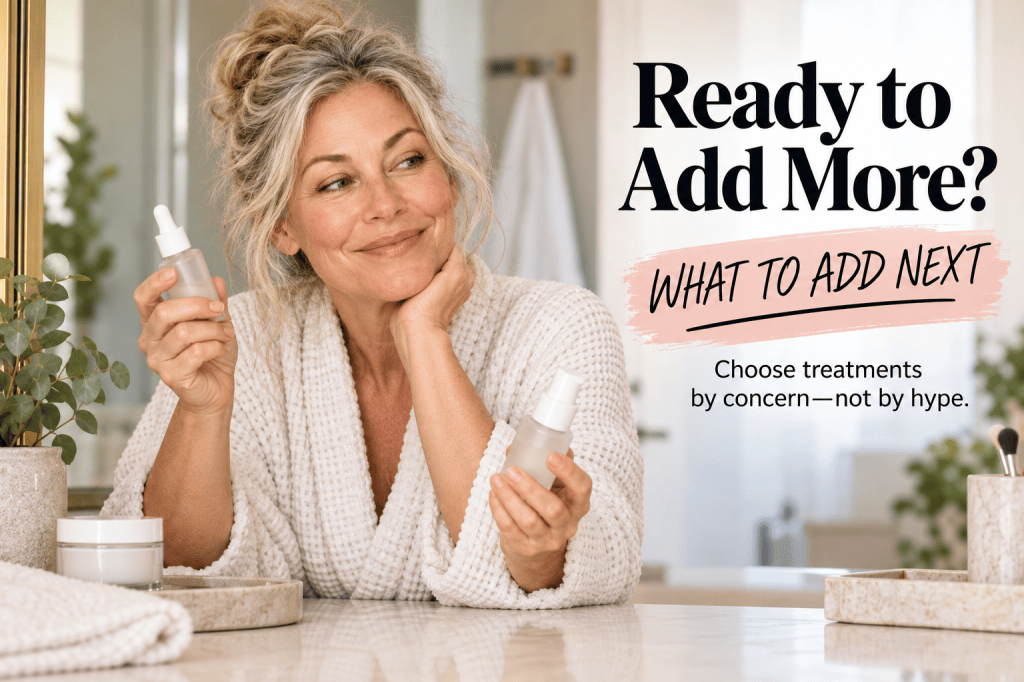
🌿 When You’re Ready to Do More
Do the basics first.
Give your skin time to settle into them.
Then ask:
What is the ONE thing I’d most like to improve?
This isn’t just my attempt to save you from owning 14 serums.
The AAD recommends establishing sunscreen and moisturizer first, then focusing on the aging concern that bothers you most. Using several new anti-aging products at once can irritate the skin. AAD: How to Select Anti-Aging Skin Care Products
If your answer is:
“Fine lines, texture and visible sun aging.”
Now we can talk about retinoids.
Prescription tretinoin has some of the strongest clinical evidence among topical treatments for photoaging. A systematic review of randomized controlled trials found consistent improvements in signs including fine and coarse wrinkles, mottled pigmentation and other features of photodamage. PubMed: Topical Tretinoin for Treating Photoaging
OTC retinol is another option, but we shouldn’t pretend all retinoids, strengths and formulations have identical evidence.
Whichever route you choose, slowly is the operative word.
You do not receive additional anti-aging points because your face is peeling off.
⚖️ Welcome to Skincare Court
This is where skincare gets expensive unnecessarily.
Once we discover that several ingredients genuinely have evidence, the natural conclusion is:
“I need all of them.”
No.
An ingredient can work and still not deserve a place in your routine.
Instead of asking:
“Is Vitamin C good?”
Ask:
“What job would Vitamin C be doing in MY routine?”
Every product needs a job opening.
🔨 The Court’s Findings
Retinoids: Strong evidence for photoaging. Hired when that’s the goal. Systematic review
Niacinamide: A legitimate multitasker. A randomized controlled study using 5% niacinamide found improvements in fine lines and wrinkles, hyperpigmented spots, red blotchiness, yellowing and elasticity after 12 weeks. That does not mean everyone needs 10% niacinamide. PubMed: Niacinamide and Aging Facial Skin
Azelaic acid: Particularly interesting for acne, rosacea and pigmentation. A systematic review found 43 randomized trials and evidence of benefit for acne, rosacea and melasma. Interestingly, it found no eligible randomized trials supporting azelaic acid specifically as a treatment for skin aging itself. PubMed: Systematic Review of Azelaic Acid
Tranexamic acid: A pigmentation specialist, with particularly interesting evidence for melasma. A 2024 systematic review and meta-analysis evaluated randomized trials of TXA for melasma and found significant improvement overall, although formulations and methods varied substantially. PubMed: Tranexamic Acid for Melasma
Vitamin C: Legitimate antioxidant with evidence for pigmentation and photoaging, but the evidence base is smaller than its enormous reputation might suggest. A 2023 systematic review found only seven eligible publications involving 139 participants. Results were encouraging, but the authors called for more research. PubMed: Topical Vitamin C in Melasma and Photoaging
AHAs/BHAs: Useful exfoliating treatments for specific problems. Nobody is required to exfoliate merely because she turned 50.
Peptides: Interesting, but “peptides” describes many different molecules rather than one ingredient with one effect. A 2026 systematic review of 19 randomized trials found modest overall wrinkle benefits, but those effects were largely driven by oral peptide formulations; elasticity and skin-density results were inconsistent. PubMed: Oral and Topical Peptides for Skin Aging
PDRN: Emerging and scientifically interesting, but topical cosmetic evidence is still young compared with established treatments such as retinoids.
🐟 The fish remains on scientific probation.
🎯 Choose the Problem Before the Product
Instead of wandering through the skincare aisle wondering what you’re “supposed” to own, start with the concern.
| If this bothers you… | An ingredient worth investigating |
|---|---|
| Fine lines/photoaging | Retinoid |
| Melasma/uneven pigmentation | TXA, azelaic acid, niacinamide or arbutin, depending on the cause |
| Acne + marks afterward | Azelaic acid, retinoid or BHA, depending on the problem |
| Rosacea/inflammatory bumps | Azelaic acid |
| Rough/dull texture | AHA, if needed |
| Oily/clogged skin | BHA and/or niacinamide may be useful |
| Extra antioxidant support | Vitamin C |
| Dehydrated/plump appearance | Good moisturizer/humectants |
| “Everyone online has this” | Not a skin concern |
And if several concerns overlap, that does not automatically mean you need several products.
Look for ingredients or products that can do more than one useful job.
🧴 About Moisturizer
You don’t need a $100 jar.
Moisturizers typically combine ingredients that help attract water, smooth and soften the skin, and/or reduce water loss.
You may see ingredients including:
Glycerin, hyaluronic acid, ceramides, squalane, dimethicone, petrolatum, panthenol and various oils and fatty ingredients.
None is magical by itself.
Hyaluronic acid isn’t automatically better because you’ve heard of it.
Ceramides aren’t mandatory.
And squalane does not involve snails.
We had an unfortunate misunderstanding at Skincare Court. 🐌
Choose primarily according to how your skin behaves, what the formulation is intended to do and whether you will comfortably use it.
If your skin is oily and you despise heavy creams, don’t buy one because the package says “mature skin.”
If your skin is dry enough to feel tight after washing, your featherweight gel may no longer be enough.
And remember that moisturizers can temporarily improve the appearance of fine lines simply by increasing hydration. AAD: Maximizing Results From Anti-Aging Products
That’s a real benefit.
It’s just not the same thing as rebuilding lost facial volume.
👁️ Do I Need Eye Cream?
Probably not automatically.
The skin around the eyes is delicate and can be more sensitive, so a specially formulated product may be useful if you have a particular concern or your normal facial products irritate the area.
But if your regular moisturizer works beautifully around your eyes?
Congratulations. You own eye cream.
It simply arrived in a larger container.
And “dark circles” aren’t one single problem. Pigmentation, visible blood vessels, puffiness, thin skin and anatomical shadowing can all contribute.
A product capable of helping one cause won’t necessarily fix another.
Caffeine has also not demonstrated an ability to remodel the human skull.
We checked.
👚 What About My Neck and Chest?
They’re skin.
They’ve also been quietly collecting sun exposure while we concentrated all our attention above the jaw.
Bring moisturizer down when needed.
Bring sunscreen onto exposed neck and chest.
Certain treatments can also be used there, but these areas may be more irritation-prone. Don’t automatically smear every active ingredient you own from your forehead to your bra line.
More treatment is not automatically better treatment.
And be especially skeptical of creams promising to “lift” substantially loose skin.
Topical skincare can improve hydration, texture, pigmentation and some features of photodamage.
It cannot recreate lost facial fat or remove substantial excess skin.
✋ Your Hands and Arms Count, Too
Hands and forearms accumulate years of incidental UV exposure.
Age spots, mottled pigmentation, wrinkles and texture changes may become increasingly noticeable with age.
So when you apply sunscreen, don’t stop at your face.
AAD guidance for middle-aged skin specifically emphasizes sun protection as a central strategy for preventing additional premature skin aging. AAD: Skin Care in Your 40s and 50s
And if you have numerous brown spots or a spot that is new, changing, bleeding, crusting, itching or simply looks different from the others, have it evaluated rather than assuming everything is an “age spot.”
Trying to make something disappear cosmetically is not a substitute for knowing what it is.
🦵 Yes, There Are Retinol Body Creams
And this is one optional product that may actually earn shelf space for the right woman.
If you’re concerned about rough texture, crepey-looking skin or photodamage on the body, a retinol-containing body moisturizer may be a convenient way to combine hydration with a retinoid.
But expectations matter.
A body cream cannot remove substantial loose skin or recreate volume lost through aging or significant weight loss.
And cellulite?
There is some clinical evidence, but please keep your expectations in the same ZIP code as reality.
A small randomized placebo-controlled trial involving 15 women tested topical retinol for six months. Researchers found measurable changes in skin elasticity and other mechanical properties at the treated sites. PubMed: Topical Retinol in the Treatment of Cellulite
That’s interesting.
It is not evidence that retinol body cream makes cellulite disappear.
So body retinol belongs under:
“I have something specific I’d like to improve.”
Not:
“Every woman needs this.”
🌎 Your Skin Tone Matters, Too
Skincare shouldn’t quietly assume every reader has fair skin.
Visible aging and pigmentation can present differently across skin tones, and people prone to post-inflammatory hyperpigmentation may need to be particularly careful about irritation.
That matters when introducing acids, retinoids and other potentially irritating treatments.
The goal of treating hyperpigmentation isn’t to make someone’s natural skin color lighter.
It’s to address uneven or unwanted excess pigmentation.
And sunscreen has to be practical across skin tones, too. If a product leaves someone looking gray or chalky, telling her she “should” wear it every day doesn’t solve the adherence problem.
The best routine is designed for the person wearing the skin, not the stock photograph on the bottle.
💰 Quality Skincare Does Not Have to Be Expensive
This may be one of the most important points in this entire article.
You do not need:
A luxury cleanser.
A $90 moisturizer.
Six serums.
A separate cream for every geographical region of your body.
Or a subscription box containing ingredients you cannot pronounce.
The AAD’s own anti-aging guidance starts with sun protection and moisturizer, then recommends addressing the single concern that bothers you most rather than piling on multiple treatments. AAD: How to Select Anti-Aging Skin Care Products
Spend where a product actually solves a problem.
Otherwise, keep your money.
Drugstore products can provide the same basic categories of evidence-backed ingredients found in considerably more expensive skincare.
Sometimes an expensive product has a more elegant texture, prettier packaging or simply makes you enjoy using it more.
That’s allowed.
Pleasure has value. It just isn’t the same thing as clinical efficacy.
💜 If You Haven’t Taken Care of Your Skin in Decades
Don’t look backward.
You can’t sunscreen the beach trip you took in 1987.
You can’t go back and wash off the makeup you slept in when your children were toddlers.
And you don’t need to compensate now by attacking your face with every active ingredient discovered since.
Start tonight.
Take your makeup off.
Wash your face gently.
Put on moisturizer if your skin needs it.
Tomorrow morning, protect exposed skin from the sun.
That’s enough to begin.
Then, if you decide you want more, add one thing because it has a job to do.
Not because you’re behind.
Not because you’re 55.
Not because somebody on TikTok has better bathroom lighting than you.
And certainly not because a salmon told you to.
🐟
A quick note: This article is for general education and isn’t a substitute for individualized medical or dermatologic advice. If you have persistent irritation, a skin condition, or a spot or lesion that is new, changing, bleeding, itching, or otherwise concerning, talk with a qualified healthcare professional.
1. American Academy of Dermatology. How to select anti-aging skin care products. Practical guidance on sunscreen, moisturizer, skin type and choosing one aging concern at a time.
AAD: How to Select Anti-Aging Skin Care Products
2. American Academy of Dermatology. Caring for your skin in menopause. Includes menopause-related dryness, acne, hair changes, loss of firmness and the estimates for collagen loss after menopause.
AAD: Caring for Your Skin in Menopause
3. American Academy of Dermatology. Skin care in your 40s and 50s. Guidance on sun protection and healthy skincare habits for aging skin.
AAD: Skin Care in Your 40s and 50s
4. American Academy of Dermatology. How to maximize results from anti-aging skin care products. Includes guidance on moisturizer, sun protection, irritation and realistic timelines for results.
AAD: Maximizing Anti-Aging Skin Care Results
5. Sitohang IBS, Makes WI, Sandora N, Suryanegara J. Topical tretinoin for treating photoaging: A systematic review of randomized controlled trials. International Journal of Women’s Dermatology. 2022.
PubMed: Tretinoin and Photoaging Review
6. Bissett DL, Oblong JE, Berge CA. Niacinamide: A B vitamin that improves aging facial skin appearance. Dermatologic Surgery. 2005.
PubMed: Niacinamide Study
7. King S, et al. A systematic review to evaluate the efficacy of azelaic acid in the management of acne, rosacea, melasma and skin aging. Journal of Cosmetic Dermatology. 2023.
PubMed: Azelaic Acid Systematic Review
8. Calacattawi R, et al. Tranexamic acid as a therapeutic option for melasma management: Meta-analysis and systematic review of randomized controlled trials. Journal of Dermatological Treatment. 2024.
PubMed: Tranexamic Acid and Melasma Review
9. Correia G, Magina S. Efficacy of topical vitamin C in melasma and photoaging: A systematic review. Journal of Cosmetic Dermatology. 2023. Seven publications involving 139 volunteers met the review’s inclusion criteria.
PubMed: Vitamin C Systematic Review
10. Nukaly HY, et al. Oral and topical peptides for skin aging: Systematic review and meta-analysis of randomized controlled trials. Frontiers in Medicine. 2026. The review included 19 randomized trials involving 1,341 participants.
PubMed: Peptides and Skin Aging Review
11. Piérard-Franchimont C, et al. A randomized, placebo-controlled trial of topical retinol in the treatment of cellulite. The study involved 15 women treated for six months.
PubMed: Retinol and Cellulite Trial
 Life Made Simple
Leave a comment