
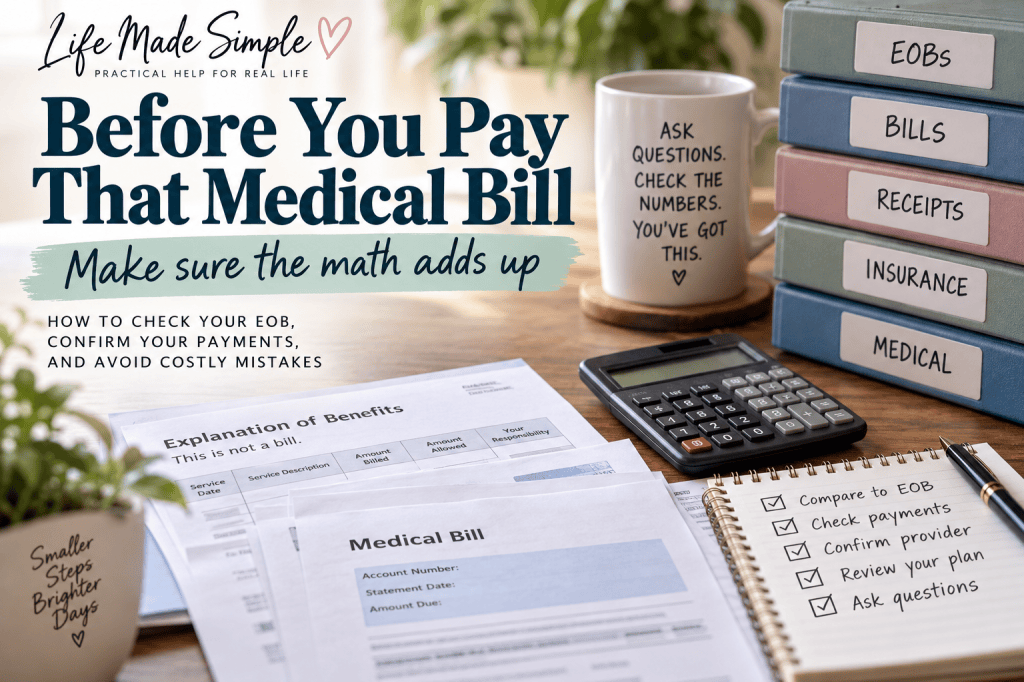
A medical bill can make your stomach drop before you even open the envelope.
Maybe you just got home from the hospital. Maybe you are still dealing with whatever sent you there in the first place. Then the paperwork starts arriving.
An EOB here. A hospital bill there. A bill from a provider you do not remember meeting. Another one from somebody whose name means absolutely nothing to you.
And somewhere in the middle of all that, somebody wants money.
Before you pay a large medical bill, slow down long enough to make sure the numbers actually add up.
Not because every medical bill is wrong.
Sometimes it is completely correct.
But sometimes the amount you are being asked to pay does not account for money you already paid, insurance has not finished processing something, or the bill simply does not match what your EOB says you owe.
You should understand that before the money leaves your account.
Start with the EOB
If you have insurance, your Explanation of Benefits is the best place to start.
The EOB is not a bill. It is your insurance company’s explanation of how the claim was processed: what the provider charged, what your plan allowed, what insurance paid, and what the insurer says may be your responsibility. CMS also points out something especially important here: an EOB may show your patient responsibility without showing money you already paid to the provider.
If EOBs still look like ancient hieroglyphics to you, start with my plain-English guide to reading one first:
Once you know what the EOB says, then you can compare it with the actual bill.
Did you already pay something?
This one is easy to forget.
During a recent hospital visit, we were asked to pay $745 up front.
Later, the EOB showed approximately $1,200 in patient responsibility.
That does not automatically mean we owe another $1,200.
If that $745 payment was applied to the same hospital account, the basic math starts here:
$1,200 patient responsibility
− $745 already paid
= $455 potentially remaining
I say potentially because you still need to make sure the payment was applied to the correct account and that nothing else changed.
This is exactly why keeping receipts matters.
And yes, I know. A hospital admission is not usually the moment when anybody is lovingly organizing receipts into a color-coded filing system.
You are worried about the person who is sick.
You are answering questions.
People are handing you paperwork.
Somebody asks for a credit card.
Then six weeks later another bill appears and Future You is expected to remember exactly what happened.
Keep the receipt anyway.
Make sure your payment was actually credited
Do not assume the provider’s billing system automatically put everything in the right place.
Compare:
EOB patient responsibility
minus any payment you already made
against the balance the provider is now requesting
CMS recommends comparing the bill with the EOB and checking both the amount insurance says you owe and any patient payments already made.
If the math does not work, call the billing office.
You can say something as simple as:
“My EOB shows $1,200 patient responsibility, but I paid $745 at the hospital. Can you show me where that payment was applied?”
You do not need to accuse anybody of doing anything wrong.
You just need the numbers reconciled.
Make sure you are comparing the same provider
Hospital visits are especially good at producing a supporting cast.
You may get separate claims or bills from:
- the hospital itself
- the emergency physician group
- radiology
- anesthesia
- pathology
- consulting specialists
- ambulance services
- other independent providers
So if you paid $745 to the hospital, do not automatically subtract that amount from the radiologist’s separate bill.
First make sure you are comparing the same provider, same account, and same episode of care.
This is one reason people can feel buried after a hospital stay. They remember going to one hospital, yet somehow seven different organizations appear in the mailbox asking for money.
We are going to talk about that separately because it deserves its own article.
Has insurance actually finished processing the claim?
Another thing worth checking before paying a large balance:
Is this claim finished?
Sometimes a provider statement arrives while insurance activity is still underway.
Look at the EOB and insurer portal.
Has the claim been processed?
Was anything denied?
Is additional information needed?
Is another claim still pending?
Did the provider resubmit something?
If you have not received an EOB at all, CMS recommends checking with your insurer to make sure the provider actually submitted the claim.
You do not want to pay a large balance simply because two computer systems are at different stages of the conversation.
If the EOB does not match what you thought your plan covered
This is another common one.
You look at the EOB and think:
There is no way our insurance works like this.
Maybe it does.
Maybe it does not.
But memory is not the place to settle the argument.
Check your actual benefits.
For an employer-sponsored plan, look for your Summary of Benefits and Coverage, often shortened to SBC, and if you need more detail, your full plan documents.
Job-based health plans are required to provide an SBC, which summarizes the plan’s benefits and costs. You can also request a copy from the insurer or group health plan.
These days, you may not have a nice paper packet sitting in a filing cabinet.
Look in:
- your insurance company’s app
- your insurer’s member website
- your employer’s benefits portal
- your HR or benefits department
- electronic documents from open enrollment
- downloadable plan documents
- the Summary of Benefits and Coverage
- the more detailed Summary Plan Description, if your employer provides one
Then look for the part of the plan that covers the service you received.
Check:
- deductible
- copay
- coinsurance
- in-network versus out-of-network benefits
- prior authorization requirements
- out-of-pocket maximum
- exclusions or limitations
For example, somebody may insist:
“We do not have coinsurance.”
Then the EOB quietly enters the room carrying $1,090 in coinsurance.
At that point, it is time to read the policy.
Insurance plans are not governed by what we remember selecting during open enrollment.
They are governed by the actual plan terms.
Do not forget your HSA or FSA
If you have an HSA or FSA, do not mentally reserve it only for pharmacy runs and doctor-office copays.
Hospital expenses may also qualify.
If the expense is an eligible medical expense under your plan and the applicable tax rules, those funds may be available to help pay it.
For an HSA, the IRS says distributions can generally be used tax-free for qualified medical expenses that were not otherwise reimbursed, and you should keep records showing what the money was used for.
So before pulling money from checking or putting a hospital bill on a regular credit card, check whether you have eligible HSA or FSA funds available.
And keep the documentation.
Future You keeps getting assignments in this article.
What if you still cannot afford the bill?
That deserves a whole article of its own.
For now, just know this:
Do not assume your only options are “pay it all today” or “ignore it.”
Hospitals and medical providers may offer payment arrangements, financial-assistance programs, or other options depending on the facility and your circumstances.
We will dig into those separately because that topic gets complicated quickly, and I do not want this article turning into a semester-long medical finance course.
Sometimes the math really does work
You may go through all of this and discover something deeply unsatisfying:
Yep. You actually owe it.
That still has value.
There is a big difference between paying a $1,200 bill while thinking:
“I have absolutely no idea why I owe this.”
and paying it knowing:
“I checked the EOB, my previous payment was credited, the bill matches my plan, and this really is my remaining responsibility.”
Sometimes the savings is money.
Sometimes the savings is avoiding a duplicate payment.
Sometimes it is catching a mistake.
And sometimes it is simply peace of mind that you are not handing over a large amount of money while still wondering whether you should.
That matters too.
Before you pay, make the numbers tell the same story
For a large medical bill, I want three things to agree:
Your EOB
Your payment history
Your provider bill
If they do not, find out why before paying.
You do not need a degree in medical billing to ask questions.
You just need to know when the numbers are not telling the same story.
And if something does not add up, that is a perfectly good reason to stop.
Keep Reading
If you are still trying to understand what your insurance company sent you, start here:
If you are trying to keep EOBs, bills, receipts, insurance information, and payment records from becoming a paper avalanche, this may help next:
How to Create a Medical Binder That Actually Helps You
Coming next:
Why Am I Getting Medical Bills From People I Don’t Recognize After a Hospital Stay?
Because apparently being admitted to one hospital does not prevent half the healthcare system from introducing itself through your mailbox.
Free Resource
If a hospital stay has made you realize your important medical information is scattered everywhere, download the free Emergency Medical Snapshot from Life Made Simple.
It gives you one simple place to keep critical information you or a family member may need quickly during an appointment, emergency, or hospital visit.
Download the Free Emergency Medical Snapshot
 Life Made Simple
Leave a comment