
Affiliate disclosure: This post contains affiliate links. I may earn a commission from qualifying purchases at no additional cost to you.
If you live in your RV year-round, winter preparation starts long before the first hard freeze.
For us, it starts when cooler weather begins creeping into the forecast.
That might seem early, especially here in Alabama. But an RV is not insulated like a traditional house, and freezing temperatures have a way of finding every weak spot you forgot existed.
I’d much rather discover in October that an electric blanket has stopped working, we’re low on propane, or something needs attention on the generator than discover it at 10 p.m. during a hard freeze.
And there’s another reason we prepare early:
Cooler weather can be some of the best camping weather of the entire year.
The goal isn’t to spend it worrying about hoses, plumbing and propane. The goal is to have those things handled so we can enjoy it.
This also isn’t traditional RV winterization. We’re not putting our motorhome into storage for the season.
We’re preparing our home to keep functioning while we’re living in it.
We Start Preparing Before It’s Actually Cold
Our motorhome is a 1992 Monaco Signature Series, so we’ve learned that waiting until something becomes an emergency isn’t a particularly good strategy.
Before freezing weather arrives, we start going through the things we’ll depend on during winter.
We bring heaters and extra blankets out of storage. We test last year’s electric blanket. We check our propane supply and fill the external propane tanks. We switch from our regular fresh-water hose to the heated one.
We also think beyond the “house” portion of the motorhome.
We start the motorhome and make sure it’s running properly. The engine and radiator get attention. We test the onboard generator and make sure there’s enough fuel in the motorhome’s tank to operate it if campground power goes out.
If something needs repairing or replacing, I’d rather know while it’s still 60 degrees outside.
This year, for example, our golf cart enclosure has reached the end of its useful life. That’s something we already know needs replacing before winter, rather than discovering it on the first cold, rainy campground day.
The time to prepare for freezing weather is not after it starts freezing.
Protect the Water Coming Into the RV
One of our first changes when cold weather approaches is simple: we replace our normal fresh-water inlet hose with a heated fresh-water hose.
Because we’re living in the motorhome rather than storing it for winter, we still need a functioning water supply.
A heated hose helps protect that incoming water connection during freezing conditions, but every RV and campground setup is different. Connections, exposed plumbing and other vulnerable areas may need additional protection depending on the RV and temperatures.
This is one of those places where it’s worth checking your own RV manufacturer’s cold-weather guidance rather than assuming one setup works for everyone.
We also keep a Travel Berkey on our counter. For us, having another water option available is useful when campground water is interrupted or we’re uncertain about the water supply.
The point isn’t that everyone needs our exact setup.
The point is to ask:
If the water coming into my RV stopped tonight, what would I do?
If the answer is I have absolutely no idea, that’s something to solve before freezing weather arrives.
Don’t Forget the Sewer Side of the Equation
And now we arrive at the glamorous chapter of RV living.
The sewer system.
We’ve already had our own adventures here. Our sewer system was horrible when we first dealt with it, and we eventually hired someone to professionally clean it. Since then, we’ve been much more deliberate about maintaining it.
Cold weather adds another problem because tanks, drain lines and sewer hoses can be vulnerable to freezing.
The RV Industry Association recommends protecting holding tanks and drain pipes in freezing conditions and discusses options such as insulation and purpose-designed heating products where appropriate.
We’ve used supplemental heating around vulnerable exterior areas in the past, but after researching current heater-safety guidance, we’re reevaluating that approach.
I would not recommend improvising with an ordinary portable space heater and combustible coverings around exterior RV plumbing.
We’re looking instead at purpose-built freeze protection and insulation that is appropriate for the location and our particular RV.
That’s an important distinction you’ll see throughout Life Made Simple:
I’ll tell you what we’ve done, but that doesn’t automatically mean I’ll tell you to do it.
Sometimes experience teaches us what works. Sometimes additional research teaches us there’s a better way to accomplish the same thing.
Have More Than One Way to Stay Warm
Our primary RV heating system uses propane, and our motorhome has an onboard propane tank.
We also keep additional external propane available.
We’ve been through cold-weather situations where propane became an important resource, and we’ve seen how quickly campground neighbors start helping each other when somebody needs something.
When appropriate, we sometimes use tall, narrow electric space heaters inside the motorhome to reduce how much propane we’re using.
I also love an electric blanket in the evening.
There is one important distinction, though:
Keeping me warm isn’t the same thing as keeping the RV warm.
The plumbing refuses to get under the electric blanket with me.
During freezing weather, we still have to maintain enough warmth in the RV to protect vulnerable plumbing. We also open certain cabinets in the evening so warmer interior air can circulate around pipes that would otherwise be trapped behind closed doors.
Portable heaters require some additional caution in an RV. Current U.S. Consumer Product Safety Commission guidance recommends keeping portable heaters at least three feet from combustible materials, plugging electric space heaters directly into a wall outlet rather than an extension cord or power strip, and turning them off when sleeping.
An RV’s electrical system also has limits. Just because several appliances can physically be plugged in doesn’t mean they should all be running simultaneously.
Deal With Drafts Before You’re Paying to Heat Them
Older RV windows can be beautiful little portals for watching campground life.
They can also be remarkably talented at reminding you it’s 28 degrees outside.
We’ve made several changes over time.
We removed the dated window boxes and curtains that originally came with our motorhome and replaced them with curtain rods and thermal curtains that better suit our style and help with temperature control.
When the old blinds eventually dry-rotted, we replaced them with room-darkening thermal roller shades.
In our bedroom, the original decorative “headboard” area wasn’t doing much for insulation. We removed the dated material, added more insulation and installed wallboard over it.
This winter we’re considering another improvement for windows we rarely use: fitted removable insulation panels covered in attractive fabric.
Because practical does not have to mean ugly.
The important consideration with removable window insulation is moisture. RVs can develop condensation quickly, so we’ll be checking behind anything we install rather than sealing a window away and forgetting about it until spring.
Don’t Forget How Cold an RV Floor Can Get
Nobody talks enough about the floor.
Cold air underneath an RV can make the floor surprisingly uncomfortable, even when the room itself feels warm.
We’ve added Ruggable runners with thicker pads through the areas where we walk most.
My husband wears house slippers.
I remain firmly committed to Team Barefoot, which means apparently I’ve chosen the more complicated solution.
Our dogs feel the cold floor too.
Their crates sit low, so we insulate underneath them with mats or folded blankets rather than letting the crate floors sit directly against a cold surface.
This year, my daughter is also helping us make washable crate pads using inexpensive jersey blankets around removable foam. The covers can come off and go to the campground laundromat without trying to wash an entire bulky dog bed.
That’s the kind of solution I love most.
Not expensive. Not glamorous.
It just solves the actual problem.
Prepare for a Power Outage Before You Have One
Campground electricity can go out just like power can go out in a house.
Our motorhome has an onboard generator, so checking it is part of our winter preparation.
We run it before cold weather arrives rather than assuming it will work because it worked the last time we needed it. We also make sure there’s enough fuel in the motorhome’s tank to operate it.
Our generator setup also includes a purpose-built exhaust extension that redirects the generator exhaust away from the RV while it’s operating.
Generator installation and exhaust requirements vary, so your RV and generator manufacturer’s instructions should always take priority.
And generator safety is serious.
Generators produce carbon monoxide, which you can’t see or smell. We follow the equipment manufacturer’s operating requirements and make sure our RV’s carbon-monoxide detection equipment is functioning properly.
A generator is a wonderful backup only when it’s operated safely.
Make Sure You Can Still Eat, Drink and, Most Importantly, Make Coffee
One of the best things we’ve done in our kitchen actually has very little to do with winter.
We generally don’t cook on the built-in propane stove.
Instead, we use a portable induction cooktop. When we’re finished with it, it gets stored underneath the counter and we get that counter space back.
That’s one of the lessons we’ve learned from living in an older motorhome:
You don’t have to use a space exactly the way the manufacturer designed it.
The people who built our motorhome in 1992 didn’t know us. They didn’t know how we’d cook, where we’d want the dog crates or what we’d find useful thirty-plus years later.
So we’ve changed things.
The propane stove remains available as an alternative cooking method, which becomes particularly useful when we’re thinking about power outages.
We also have an AeroPress for coffee, which requires no electricity. Give me hot water and coffee grounds and civilization can continue.
Our RV has a near-boiling hot-water faucet near the kitchen sink, and we also have a kettle that can be heated using propane if necessary.
Could winter still create problems?
Absolutely.
But we intend to face those problems caffeinated.
Check the Motorhome, Not Just the House Part
When an RV stays parked for long periods, it’s easy to start thinking of it entirely as a tiny house.
It isn’t.
It’s still a motorhome.
Before winter, we start it and make sure everything is operating as expected. We check the engine and radiator, exercise the generator and make sure we have adequate fuel.
Specific maintenance needs vary considerably by chassis, engine, generator and RV manufacturer, so this is another area where your own manuals and qualified technicians matter.
Our basic philosophy is simpler:
We don’t want the first indication of a mechanical problem to happen when we actually need the motorhome to move.
Our Two-Way Rule for RV Preparedness
Over time, we’ve developed what I think of as our Two-Way Rule.
For the things that matter most, I ask:
If my normal way of doing this stopped working tonight, do I have another way?
Heat?
Water?
Cooking?
Hot water?
Electricity?
Transportation?
Communication?
We don’t need three elaborate backup systems for everything. We’re also not trying to prepare for the collapse of civilization.
We just don’t want one ordinary failure to immediately become an emergency.
For us, that means things like propane heat plus appropriate supplemental electric heat. Induction cooking plus the propane stove. Campground electricity plus the onboard generator. Our normal water connection plus a plan for interruptions.
And, obviously, more than one route to coffee.
Campground Community Is Part of Preparedness Too
There’s another resource that doesn’t fit into a storage compartment.
Other campers.
One of the things we love about campground living is how quickly people tend to help one another when something goes wrong.
We’ve shared propane and supplies during difficult situations, and we’ve watched neighbors help each other troubleshoot problems, move things, check equipment and get through weather events.
Preparedness doesn’t necessarily mean being completely self-sufficient.
Sometimes it means having enough margin that you can help the camper next door too.
Winter Should Still Feel Like Camping
Preparing for colder weather isn’t just about preventing frozen pipes or making sure we have enough propane.
Some of our favorite campground weather comes when the temperatures cool down.
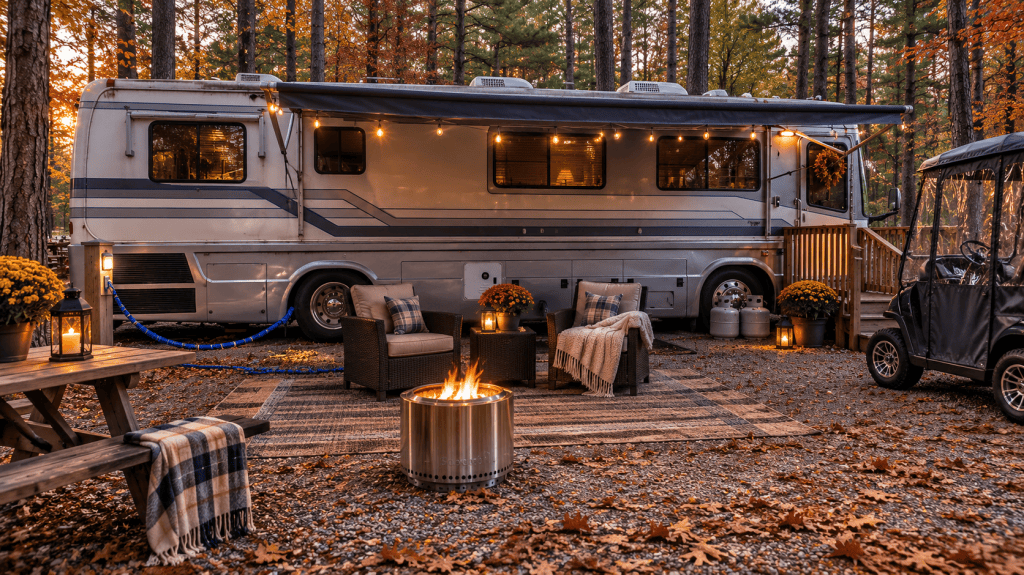
Under the right conditions, fall and early winter can be some of the best times to enjoy RV living. The air is cooler, the campground feels different, and sitting outside around a campfire is a whole lot more appealing than it was during the middle of an Alabama summer.
We have a Solo Stove that we use for campfires, and this is the time of year when we really get to enjoy it.
Inside, our extra winter blankets come out of storage. Some of them live over the motorhome’s cab and steering-wheel area, where they’re easy to grab and also help make that part of the motorhome feel a little less like a driver’s compartment and a little more like home.
Outside, the winter enclosure goes onto the golf cart. We use that cart for everything from taking laundry to the campground laundromat to hauling boxes to the dumpster, and our dogs are always happy to volunteer for a ride.
We make the RV warmer.
We make the campsite cozier.
And then we enjoy the season.
That’s really the reason we prepare early. We don’t want to spend the first beautiful cold weekend scrambling to solve problems we could have handled while it was still warm.
Winter preparation isn’t about dreading cold weather.
It’s about being ready enough to enjoy it.
What We’re Changing This Winter
One thing I don’t want this site to become is a collection of articles pretending we’ve already perfected everything.
We haven’t.
This winter, we’re planning to replace our aging golf-cart enclosure. We’re making better washable insulated pads for the dogs’ crates. We’re experimenting with attractive removable insulation for some of our draftier windows.
And we’re reevaluating how we protect vulnerable exterior plumbing during freezing conditions so we can use a more purpose-designed solution.
I’ll share what works.
I’ll also share what doesn’t.
Because buying three things that don’t solve the problem before finally finding the thing that does isn’t particularly “simple.”
And if we’ve already done some of that experimenting, maybe you won’t have to.
Start Before the Weather App Turns Blue
If you live in your RV through winter, don’t wait for the first freeze warning to start thinking about cold-weather preparation.
Test the equipment you’ve stored since last winter.
Check your water setup.
Think about exposed plumbing.
Check propane and fuel.
Run the generator.
Look for drafts.
Bring out the blankets.
Think about your pets.
And then ask yourself one question:
If one of the systems I depend on stopped working tonight, what would I do next?
You don’t need to prepare for every possible disaster.
You just want an ordinary winter problem to remain an inconvenience instead of becoming an emergency.
And once you’ve done that?
Light the campfire. Grab a blanket. Make something warm to drink.
This can be some of the best camping weather of the year.
That’s why we’re thinking about winter while it’s still warm outside.
A Quick Safety Note
This article is based partly on our own experience living in our motorhome. RVs vary considerably in construction, insulation, electrical capacity, plumbing, heating systems, generators and cold-weather capability. Always follow the instructions for your specific RV and equipment, and use a qualified RV technician or other professional when a repair or installation is beyond your experience. Never operate generators or fuel-burning equipment in a way that could allow carbon monoxide to enter an occupied space.
 Life Made Simple
Leave a comment