
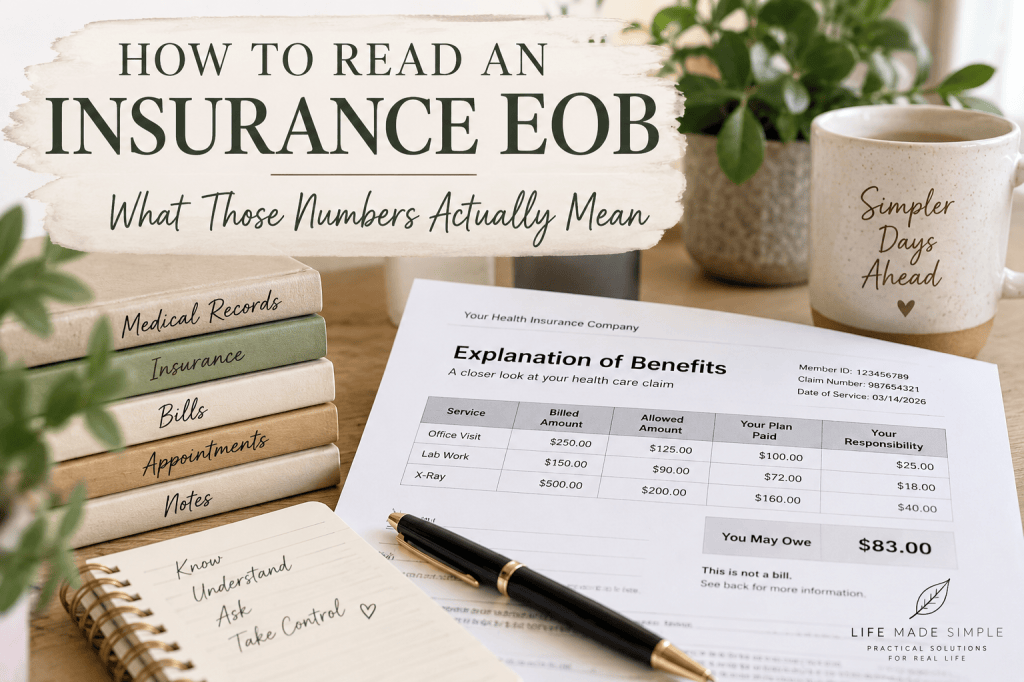
What the charges, discounts, deductible, coinsurance, and “you may owe” amounts actually mean
You go to the doctor.
A few weeks later, something arrives from your health insurance company.
It says your provider charged $1,200.
Then there are discounts, allowed amounts, insurance payments, deductibles, coinsurance, codes, and somewhere near the bottom you see:
YOU MAY OWE: $347.82
Before you panic, pay anything, or decide you’re never going to the doctor again, there is one very important thing to know:
An Explanation of Benefits is not a bill.
An Explanation of Benefits, usually called an EOB, is a statement from your health insurance company explaining how it processed a claim.
It tells you what the provider charged, what your insurance plan allowed, what insurance paid, and what portion may be your responsibility.
It can look intimidating.
But once you understand a handful of terms, an EOB becomes much easier to read.
First: What Actually Happened to the Money?
This is probably the most confusing part of an EOB.
Imagine your doctor submits a claim for:
$500
That does not necessarily mean your doctor will receive $500.
Let’s say your doctor is in your insurance network and the insurance company’s negotiated amount for that service is:
$200
The claim might look something like this:
Provider billed: $500
Insurance adjustment/discount: −$300
Allowed amount: $200
Insurance pays: −$160
Your coinsurance: $40
Your doctor did not receive $500.
Your insurance company did not pay the missing $300.
And you generally aren’t responsible for that $300 contractual adjustment when the service is covered and the provider is subject to the insurer’s negotiated rate.
The provider agreed to accept the plan’s allowed amount under its contract with the insurer.
CMS specifically distinguishes the provider charge, allowed charge, and amount paid by the insurer when explaining an EOB.
This gives us one of the most important things to remember when reading an EOB:
Provider charge ≠ allowed amount ≠ insurance payment ≠ what you owe.
They are different numbers.
A Short Health Insurance Glossary
Insurance companies have somehow managed to make spending money considerably harder to understand than it needs to be.
Here are the terms you’re most likely to encounter.
Premium
The amount you pay to have health insurance.
Paying your premium does not mean all your healthcare is now free.
Your plan may still require deductibles, copays, and coinsurance.
Deductible
The amount you generally must pay toward covered healthcare services before your insurance starts paying its share for services subject to the deductible.
If your plan has a $2,000 deductible, for example, you may be responsible for significant healthcare costs before your insurer begins sharing those particular costs.
Not every service is necessarily subject to the deductible, so check your individual plan.
Copay
A fixed amount you pay for a covered service.
For example:
$30 primary-care visit
or
$50 specialist visit
Coinsurance
Instead of a fixed dollar amount, coinsurance is a percentage of the allowed cost that you’re responsible for.
For example:
Allowed amount: $1,000
Your coinsurance: 20%
Your portion: $200
Allowed Amount
This is one of the most important numbers on your EOB.
It’s the maximum amount your health plan recognizes for a covered service under the applicable plan arrangement.
You may also see it called:
Negotiated rate
Eligible expense
Payment allowance
The allowed amount may be substantially lower than what the provider originally billed.
Adjustment / Contractual Discount
This is an amount removed from the original charge based on the provider’s arrangement with the insurer.
If a provider charges $500 but its contracted allowed amount is $200, you might see a $300 adjustment.
That does not mean your insurance company paid $300.
Patient Responsibility
This is the portion the insurance company has assigned to you after processing the claim.
It may include:
Deductible
Copay
Coinsurance
or certain non-covered amounts.
One important wrinkle: your EOB may say you owe $100 even if you already paid $100 at the doctor’s office.
Your insurer may not know you’ve already paid it.
CMS specifically warns consumers about this.
Out-of-Pocket Maximum
This is the most you generally pay during the plan year in applicable cost-sharing for covered in-network services.
It is not necessarily the most you’ll spend on healthcare altogether. Premiums and certain other expenses may not count toward it.
Denied / Non-Covered
This means insurance did not pay the claim or service as submitted.
But here’s something important:
Insurance didn’t pay it does not automatically mean you should immediately pay it.
Find out why it wasn’t paid.
The claim may need additional information, correction, another insurer may be responsible, the service may require an appeal, or it may legitimately be your responsibility.
Look for the explanation or remark code on your EOB.
How to Read Your EOB in 5 Minutes
You do not need to analyze every mysterious number on the page.
Start here.
1. Make sure the basics are correct.
Check:
Patient name
Provider
Date of service
Type of service
Did you actually receive the service listed?
2. Find the provider’s original charge.
Interesting information.
But don’t panic over this number.
It may not be anywhere close to what ultimately gets paid.
3. Find the allowed amount.
This tells you much more about the actual economics of the claim.
4. Find what insurance paid.
Now you can see the portion actually paid by the insurer.
5. Find your patient responsibility.
This is the number you eventually want to compare with the provider’s actual bill.
Before You Pay a Medical Bill, Check These 5 Things
Eventually, you may receive an actual bill from the doctor’s office, hospital, laboratory, or other provider.
Now compare it with your EOB.
Ask:
1. Did I receive these services?
Check the dates and descriptions.
2. Has insurance finished processing the claim?
Don’t assume a bill is correct if insurance hasn’t finished processing the corresponding claim.
3. Does the provider bill reflect insurance adjustments and payments?
Look for the insurer’s payment and applicable adjustments.
4. Does the amount the provider says you owe match the patient responsibility shown on the EOB?
CMS says your provider bill generally should not be higher than the patient balance shown on the EOB. If it is, contact the provider.
5. Have I already paid part of this?
Maybe you paid a copay or deposit when you received the service.
Make sure you’re getting credit for it.
What If the EOB and the Bill Don’t Match?
Don’t automatically pay the bill just because it arrived.
But don’t automatically assume the provider is wrong either.
Investigate.
Call the provider’s billing department and/or your insurance company.
Have your EOB and bill in front of you.
Ask exactly what caused the difference.
And document the conversation:
Date you called
Who you spoke with
Reference number, if available
What you were told
What they’re going to do next
When you should follow up
This is exactly the kind of information that’s nearly impossible to reconstruct three months later when somebody says:
“We don’t have any record of that conversation.”
Naturally. 😂
If keeping up with EOBs, medical bills, insurance calls, medications, and provider information is becoming a job of its own, visit our Medical Organization Hub. It brings our medical organization guides and resources together in one place so you can find what you need without adding more chaos to the pile.
What About Medicare?
If you have Original Medicare, your paperwork may look somewhat different.
Instead of a traditional EOB for Medicare Part A and Part B services, you’ll generally receive a Medicare Summary Notice, or MSN.
The principle is similar.
You’ll see information including what the provider charged, the Medicare-approved amount, what Medicare paid, and the maximum you may be billed.
Again:
The amount the provider charged is not necessarily the amount Medicare paid.
Can’t Afford the Amount You Really Do Owe? Ask About Financial Assistance.
This is something many patients simply don’t know exists.
If you’ve reviewed the EOB and provider bill and the balance appears legitimate, but you cannot afford it, don’t assume your only choices are:
Pay it immediately
or
Ignore it.
Call the hospital or provider and ask:
“Do you have a financial assistance or charity-care program, and can I get a copy of the eligibility policy and application?”
Many hospitals have financial-assistance programs.
Tax-exempt hospitals subject to federal §501(r) requirements must maintain written Financial Assistance Policies explaining eligibility criteria, what assistance is available, and how patients can apply.
Eligibility varies.
Having insurance also does not necessarily mean there is no reason to ask. Your insurance may have processed the claim correctly while leaving you with a deductible or coinsurance amount you genuinely cannot afford.
And here’s another important distinction:
An insurance adjustment is not the same thing as financial assistance.
If a hospital charged $10,000 but its insurer contract reduced the allowed amount to $4,000, that $6,000 contractual adjustment is not automatically charity care granted to you. The IRS specifically distinguishes third-party contractual adjustments from financial assistance.
Whether you’re eligible for additional assistance with your remaining balance depends on the provider’s applicable financial-assistance policy.
So ask.
You may not qualify.
But don’t disqualify yourself without checking.
And Please Don’t Just Ignore the Bill
There’s another misconception worth clearing up.
You may have heard that medical bills can’t be sent to collections or can’t affect your credit anymore.
Don’t rely on that.
Unpaid medical bills can still be sent to third-party collection agencies. Current federal consumer guidance continues to address medical debts placed with outside collectors.
If you legitimately owe a medical balance and cannot pay it, your safest approach isn’t to throw the bill in a drawer and hope it eventually decomposes.
Instead:
Check it for accuracy.
Make sure insurance processed it correctly.
Ask about financial assistance if you may qualify.
Ask the provider about available payment arrangements if necessary.
Keep records of what you’ve done.
Ignoring a bill doesn’t resolve the underlying balance.
Keep the EOB Until the Claim Is Resolved
You don’t necessarily need a lifetime museum collection of EOBs.
But while a claim is active, keep the related paperwork together:
EOB
Provider bill
Receipts or proof of payments
Appeal or denial information
Notes from phone calls
If something goes wrong, you have the story of the claim in one place.
And if you’re managing medical care for yourself, a spouse, an aging parent, or someone with multiple providers, this becomes even more important.
That’s one reason I created the Life Made Simple Medical Organizer with places to track insurance information, providers, medications, medical documents, and insurance calls.
The goal isn’t to create more paperwork.
It’s to make the paperwork you’re already dealing with easier to understand and easier to find when you need it.
If you’re managing ongoing medical care, keeping EOBs, bills, insurance information, and notes from billing calls together can make follow-up much easier. I have a step-by-step guide to creating a medical binder that shows you how to organize all of it in one place.
The EOB Doesn’t Have to Be Scary
When one arrives, remember:
It’s not a bill.
Find the original charge.
Find the allowed amount.
Find what insurance actually paid.
Find what insurance says is your responsibility.
Then compare that amount with the provider’s bill.
If something doesn’t make sense, ask before you pay.
If the legitimate balance is more than you can afford, ask whether financial assistance is available.
And if you owe the bill, don’t simply ignore it because you’ve heard medical bills no longer matter.
A little understanding can prevent a lot of confusion.
And sometimes making healthcare simpler doesn’t require understanding the entire American insurance system.
Thank goodness.
You just need to know what this piece of paper is telling you and what to do next. 🌿
 Life Made Simple
Leave a comment