
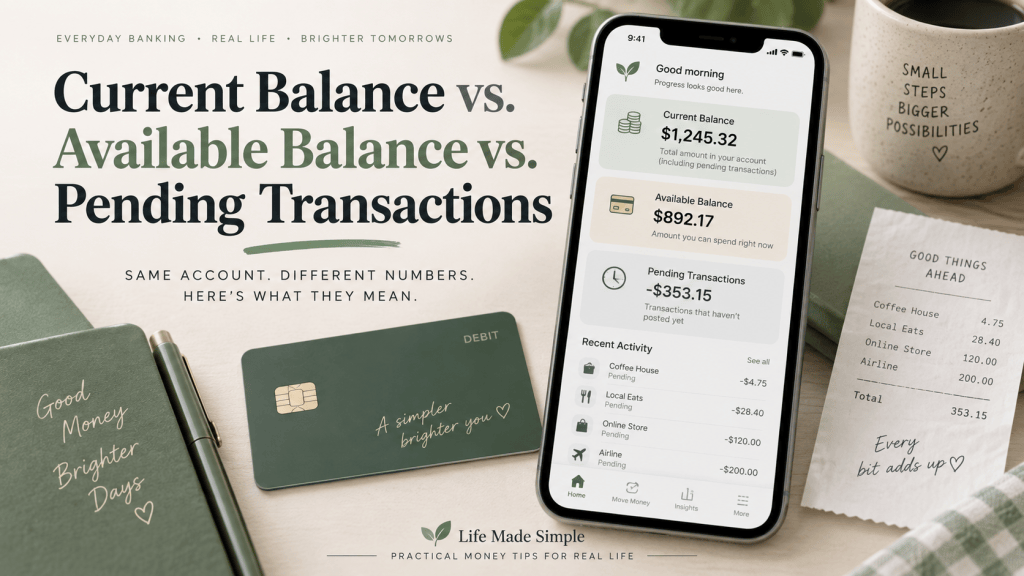
You open your banking app and see three different numbers.
Your current balance says one thing.
Your available balance says something else.
Then there are several transactions sitting there marked pending.
So how much money do you actually have?
Welcome to one of the most confusing parts of having a checking account.
If you’re new to banking, the important thing to know is that these numbers are not necessarily contradicting each other. They are showing you different stages of what is happening inside your account.
Once you understand what each one means, your banking app starts making a lot more sense.
If you’re completely new to checking accounts, debit cards, deposits, and basic banking, you may want to start with Money Basics for Young Adults and then come back here.
What Is Your Current Balance?
Your current balance generally reflects the money that has officially posted to your account.
Think of this as the bank’s completed record at that moment.
If you had $500 in your account and a $75 electric bill officially posted, your current balance would be:
$425
Pretty simple.
The confusion starts when you have transactions that haven’t finished processing yet.
What Is a Pending Transaction?
A pending transaction is something the bank knows about, but that has not completely processed yet.
For example, suppose your current balance is:
$425
Then you use your debit card to spend $40 at the grocery store.
The grocery-store transaction may first appear as:
Pending: $40
Your current balance might still show $425 because that transaction has not officially posted yet.
But that does not mean you still have $425 available to spend.
That $40 purchase already happened.
Which brings us to the number that usually matters most when you are deciding whether you can afford another purchase.
What Is Your Available Balance?
Your available balance is generally the amount the bank currently considers available for you to use.
Using our example:
| Account activity | Amount |
|---|---|
| Current balance | $425 |
| Pending grocery purchase | -$40 |
| Available balance | $385 |
Your current balance is still showing the transactions that have completely posted.
Your available balance is accounting for that $40 you already spent.
So if you are standing in Target trying to decide whether you have enough money to buy something else, the available balance is usually the more useful number to look at.
But there is an important catch.
Your Available Balance Is Not a Substitute for Keeping Track of Your Money
Your banking app can only show transactions the bank knows about.
There may be things you have already agreed to pay that haven’t reached the bank yet.
Suppose your app says:
Available balance: $385
But yesterday you wrote a $100 check that hasn’t been deposited yet.
As far as the bank knows, you may have $385 available.
But you know that $100 of it already has a job.
For your own budgeting purposes, you really have closer to:
$285
The same thing can happen with certain electronic payments or transactions that haven’t shown up yet.
This is why checking your banking app is helpful, but it doesn’t completely replace keeping track of what you spend.
Why Do Pending Transactions Sometimes Change?
Here is another thing that makes people think their bank account has become possessed.
A pending transaction may not always be the exact amount that eventually posts.
This can happen with certain types of purchases.
Restaurants
You may initially see the amount of the meal pending before the final transaction includes your tip.
Gas Stations
Some gas stations place a temporary authorization on your account before the final amount you pumped is known.
Some gas stations may place a temporary hold for more than the amount you actually purchase, then replace it with the final amount once the transaction finishes processing.
Hotels and Rental Cars
Hotels and rental-car companies may authorize an amount to cover the expected bill plus possible additional charges.
The final posted transaction may be different.
This is one reason you should leave yourself some breathing room in your checking account whenever possible.
Why Did My Pending Transaction Disappear?
This one causes understandable panic.
Sometimes a pending transaction disappears before the final transaction posts.
That does not necessarily mean the charge was canceled.
A debit-card authorization can expire or disappear from the pending section while the merchant is still completing the final transaction.
Then the charge may appear again when it officially posts.
So this is dangerous thinking:
“That $60 charge disappeared, so I guess I have another $60.”
Maybe.
But don’t spend it again until you know what happened to the original transaction.
What About Deposits?
Deposits can have their own version of this problem.
Just because you deposited a check does not always mean every dollar from that check is immediately available to spend.
Depending on the deposit, the bank may make some or all of the money available right away, or there may be a hold while the check is processed.
That is why you might see a deposit reflected somewhere in your account while your available balance still doesn’t include the entire amount.
If you aren’t sure when deposited funds will become available, ask your bank.
Here’s a More Realistic Example
Suppose you start with $1,000.
Your rent of $600 has already posted.
Your current balance is now:
$400
But you also have:
- $45 in groceries pending
- $30 in gas pending
Your available balance might be around:
$325
But you also wrote a $50 check that hasn’t reached the bank yet.
Your app doesn’t know about that check.
You do.
For your own purposes, you should be thinking:
About $275 is actually uncommitted.
That is the difference between checking your bank balance and actually managing your money.
The Number on Your Screen Is Only Part of the Story
Here is the easiest way to remember the difference:
Current balance:
What has officially posted.
Pending transactions:
Transactions the bank knows about but that haven’t completely finished processing.
Available balance:
What the bank currently considers available for you to use after accounting for certain pending activity and holds.
Your actual spending room:
Your available balance minus anything you know you’ve spent or committed that hasn’t appeared yet.
That last one is the number only you can know.
The Bottom Line
Your banking app isn’t showing three different answers to the same question.
It’s showing three different pieces of information.
Once you know what current, available, and pending mean, those numbers become much easier to understand.
And the most important lesson may be this:
Your bank can keep track of the transactions it knows about. You still need to keep track of the ones it doesn’t.
That little habit can prevent a surprising number of overdrafts, declined purchases, and moments of staring at your phone thinking:
“Where did my money go?”
Money Basics Series
New to banking and everyday money management? Start with Money Basics for Young Adults and follow the series as we break down checking accounts, debit cards, overdrafts, paychecks, and the everyday money questions nobody seems to explain before you’re expected to know them.
 Life Made Simple
Leave a comment