
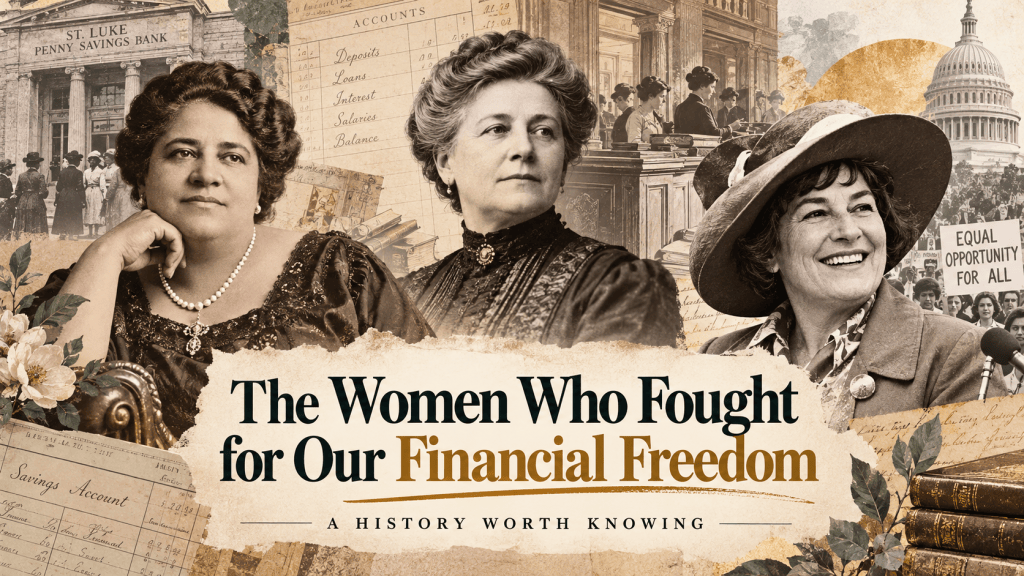
Women didn’t suddenly become financially capable in 1974. They fought for financial institutions to recognize capabilities they already had.
Imagine working, earning a paycheck, paying household bills, and contributing to your family’s financial security, only to be told you need your husband’s name on a credit application.
It sounds absurd today. But for many American women, it was a familiar experience well into the twentieth century.
Women could be responsible for managing household money while being denied the opportunity to establish credit independently. Some lenders discounted their earnings or assumed they would eventually leave the workforce to have children.
The restrictions weren’t limited to credit. Earlier generations of married women had faced legal barriers to controlling property, entering contracts, and keeping their own earnings.
These practices didn’t disappear because society gradually decided to be fair. Women challenged them through business ownership, community organizing, legal reform, and persistent pressure on financial institutions.
And the fight looked different depending on a woman’s race, marital status, and economic circumstances.
To appreciate how far we’ve come, we need to understand what women were up against.
1903: Maggie Lena Walker Opens a Bank in Segregated Virginia
On November 2, 1903, nearly 300 people gathered to open accounts at the newly established St. Luke Penny Savings Bank in Richmond, Virginia.
Its president was Maggie Lena Walker, a Black businesswoman and community leader.
Walker understood that African Americans in the segregated South had limited access to financial services. Banks could help families build savings, purchase homes, and establish businesses, but those opportunities were not equally available.
She decided to help create an alternative.
Through her leadership of the Independent Order of St. Luke, Walker organized the resources needed to establish the bank. She even spent two hours a day studying banking operations at another Richmond institution to prepare for the position.
Walker became the first African American woman to charter a bank in the United States.
Her bank produced measurable results.
By 1920, St. Luke Penny Savings Bank had helped finance more than 600 mortgages for Black families in Richmond. It also provided employment opportunities and supported Black-owned businesses.
Walker was accomplishing this during the Jim Crow era, when racial segregation and discrimination affected nearly every part of economic life.
Her story matters because it demonstrates that women were not merely requesting financial opportunities. Some were building the institutions necessary to provide them.
She was also not the only early woman banker.
In Texas, Anna Martin founded the Commercial Bank of Mason in 1901 at age 58. Martin was a successful businesswoman who became one of America’s early female bank founders.
Their circumstances were very different. Martin was white and had resources and opportunities that Walker, as a Black woman in the segregated South, did not enjoy.
But both challenged the assumption that banking leadership belonged exclusively to men.
Sources: National Park Service, St. Luke Penny Savings Bank and Early Women in Banking.
Before Women Could Control Their Financial Lives, the Laws Had to Change
For much of early American history, married women’s rights were shaped by the legal doctrine of coverture.
Under traditional coverture, a married woman’s legal identity was largely incorporated into her husband’s. Her independent rights to own property, control earnings, and enter contracts could be severely restricted.
Marriage affected more than a woman’s surname or household responsibilities. It could affect her legal authority over money and property.
Unmarried women often had different rights, and laws varied by state. But marriage placed significant restrictions on many women’s economic lives.
During the nineteenth century, states gradually passed Married Women’s Property Acts expanding married women’s rights to own property, retain earnings, and conduct business.
Those changes unfolded over decades.
And even when the laws improved, attitudes and institutional practices didn’t necessarily follow at the same pace.
A woman might have the legal right to own property while still encountering discriminatory treatment when seeking a loan.
That distinction would become especially important during the twentieth century.
When a Woman’s Paycheck Didn’t Carry the Same Weight
By the 1960s and early 1970s, women were increasingly participating in paid employment.
Yet some lending practices still treated a woman’s income as less dependable than a man’s.
A mortgage lender might discount part of a married woman’s earnings because she could become pregnant or leave her job to raise children.
Some lenders asked women questions about their family plans that weren’t routinely asked of men. In certain cases, women encountered demands for medical assurances concerning pregnancy.
A woman could have steady employment and a responsible payment history yet be evaluated according to assumptions about what she might do as a wife or mother.
There was another problem.
Many married women who helped pay household debts did not establish credit histories in their own names. Credit accounts were often maintained under their husbands’ identities.
If a marriage ended through divorce or death, a woman could discover that years of financial responsibility hadn’t established the independent credit record she needed.
Consider the consequences.
She might need to rent or purchase housing, obtain transportation, or borrow money for an emergency, but have difficulty demonstrating her creditworthiness.
The issue wasn’t necessarily whether she understood money or could handle financial responsibility.
The institution evaluating her didn’t always recognize her as an independent financial customer.
Emily Card Knew the Problem Because It Happened to Her
One of the women who helped change federal lending law had experienced discrimination herself.
Emily Card was a university professor earning her own income. Her husband was a graduate student without income.
When she attempted to obtain a credit card in her own name, the bank refused to issue it independently of her husband.
The person earning the money was not the person the bank wanted to recognize.
In 1973, Card became a congressional fellow in the office of Republican Senator William Brock of Tennessee.
She encountered research and testimony documenting similar experiences among other women.
Women’s organizations had been collecting complaints, gathering evidence, and advocating for changes in credit practices. Card began studying the issue and working with those organizations.
Initially, Senator Brock was reluctant to support federal legislation. He believed the problem might be better addressed at the state level.
Card researched the issue and persuaded him otherwise.
She helped develop legislation addressing sex discrimination in lending and was present in the Senate when it passed.
Meanwhile, Congresswoman Bella Abzug had introduced legislation aimed at prohibiting discrimination based on sex or marital status.
Bella Abzug was already serving in the United States House of Representatives when she introduced legislation challenging discrimination against women seeking credit.
A historical account reports that even Abzug encountered this discrimination when American Express required her husband’s signature for a credit card.
Consider the contradiction. A woman could serve in Congress, participate in making federal laws, and still encounter a lender that treated her husband’s approval as necessary for her own financial affairs.
Her position, education, and professional accomplishments did not automatically protect her from the assumptions applied to women seeking credit.
That helps explain why these reforms mattered. Discrimination was not limited to women who lacked income, education, or professional standing.
Other lawmakers, advocates, and women’s organizations contributed to the effort.
The legislation required more than identifying an unfair practice. Supporters had to document discrimination, build political support, work through congressional procedures, and address opposition to federal intervention.
The stories of Card and Abzug make the struggle unusually personal.
A woman who had been denied credit despite having her own income helped change the federal law governing that very practice.
Source: Smithsonian, Voices on Independence.
October 28, 1974: What Actually Changed?
On October 28, 1974, President Gerald Ford signed the Equal Credit Opportunity Act (ECOA).
The original law prohibited discrimination in credit transactions based on sex or marital status.
That was a major change in federal lending law.
But there’s a common misunderstanding worth correcting.
Women were not universally prohibited from opening checking or savings accounts until 1974.
Many women had maintained deposit accounts independently for decades. Their rights and experiences varied throughout American history.
The Equal Credit Opportunity Act addressed discrimination in obtaining credit, including loans, mortgages, and credit cards.
It challenged practices that allowed lenders to treat an applicant’s sex or marital status as a basis for denying financial opportunities.
The difference matters because it helps us understand the actual achievement.
Women were fighting to have their income, repayment history, and qualifications evaluated without discriminatory assumptions about gender or marriage.
But passing the law did not instantly remove every barrier.
Financial institutions had to change their procedures. Regulators had to implement the law. And women still needed ways to challenge discrimination when it occurred.
Source: Federal Reserve, Equal Credit Opportunity Act.
Why Was Changing the Law So Difficult?
The resistance was not limited to banking procedures.
Financial independence was closely connected to the expectations American society placed on men and women.
For generations, men had commonly been viewed as the household’s primary financial providers. Women were expected to manage domestic responsibilities, often while depending on their husbands for financial security.
Those arrangements influenced how lenders assessed women.
A bank employee who assumed a wife would eventually stop working might consider her income less reliable. A lender accustomed to dealing with husbands as the primary borrowers might expect a woman to obtain her husband’s signature.
These assumptions could become standard practices even when they were poor measures of an individual applicant’s financial reliability.
Financial institutions also raised concerns about the costs and practical requirements of complying with new regulations.
And the broader women’s rights movement faced organized resistance.
During the 1970s, the proposed Equal Rights Amendment became the focus of a national debate over marriage, family responsibilities, and gender roles.
Activist Phyllis Schlafly and the STOP ERA movement argued that constitutional sex equality could threaten certain legal protections available to wives and homemakers.
Opponents raised concerns about support obligations, military conscription, and changes to traditional family arrangements.
Supporters argued that women should not face legal restrictions or unequal opportunities because of their sex.
It’s important to distinguish these debates. The Equal Rights Amendment and the Equal Credit Opportunity Act were separate measures, and opposition to one did not automatically mean opposition to the other.
Still, they occurred during the same period of social change.
The country was reconsidering assumptions about marriage, employment, motherhood, and financial authority.
And those questions had real economic consequences.
A woman with independent access to credit and financial resources had options that might not have been available to her mother or grandmother.
She could have more opportunity to establish housing, build a business, accumulate assets, or manage her affairs after divorce or widowhood.
For women facing controlling or abusive relationships, financial resources could also affect their practical ability to leave, although access to money alone never guarantees safety.
Financial independence wasn’t simply about borrowing money.
It could change the choices available in a woman’s life.
Sources: National Archives, Equal Rights Amendment and Smithsonian, Voices on Independence.
The Fight Was Not the Same for Every Woman
The 1974 law addressed sex and marital-status discrimination, but those were not the only barriers American women faced.
Black women and other women of color frequently encountered discrimination rooted in both race and sex.
And financial opportunity depended on much more than the ability to submit a credit application.
Some communities had limited access to financial institutions. The Smithsonian notes that many Native American women living on reservations in the 1970s faced the more immediate problem of having no local banks.
For women living in poverty, a lack of dependable income or access to financial services could present barriers that legal protections alone could not solve.
Congress expanded the Equal Credit Opportunity Act in 1976 to explicitly prohibit additional forms of credit discrimination, including discrimination based on race, color, religion, national origin, and age, along with other specified grounds.
The expanded protections took effect in 1977.
Earlier civil rights legislation had already addressed certain forms of racial discrimination, including in housing. The 1976 amendments broadened explicit protections under the federal credit law.
This history is one reason Maggie Lena Walker’s work is so significant.
She understood decades earlier that financial progress required more than removing a legal restriction.
People also needed institutions willing and able to serve them.
Sources: Federal Reserve, History of Credit Protections and Smithsonian American Women’s History Museum.
1978: Women Opened a Bank to Address the Problems That Remained
By 1978, the Equal Credit Opportunity Act had been law for several years.
Yet women still encountered obstacles when applying for loans, and many did not know what protections the law provided.
In Denver, Colorado, a group of women decided to build a financial institution that would address those problems.
Carol Green and Bonnie Andrikopolous began organizing the Women’s Bank in 1975.
The bank opened on July 14, 1978, with B. LaRae Orullian as its first president.
On opening day, deposits exceeded $1 million.
The Women’s Bank served both women and men, but it placed particular emphasis on helping women access financial services and understand their options.
It offered financial education seminars and worked with community organizations.
That combination is worth noticing.
The women behind the bank recognized that changing lending laws was not enough if customers still lacked information about their financial rights.
The bank’s work addressed both access and education.
And financial education remains relevant for exactly that reason.
Source: Denver Public Library, A Bank for All People: Remembering the Women’s Bank.
What We Can Learn From Their Work
Today, many of the financial activities women once struggled to undertake independently are part of ordinary life.
Women open bank accounts, establish credit, buy property, operate businesses, and manage investments.
Those opportunities are now protected by laws that earlier generations helped bring about.
But knowing that you have financial rights isn’t quite the same as understanding how to use them.
And financial education isn’t something that should end when you graduate from school.
Whether you’re opening your first checking account at 18, managing family finances at 45, or learning to handle accounts independently at 70, there’s always something worth understanding better.
You might begin by learning:
- Which bank accounts are in your name, who can access them, and how they work.
- How to review your income, expenses, and outstanding debts.
- How credit reports, interest rates, and loan terms affect your finances.
- Whose names appear on property, insurance policies, and other important documents.
- How to protect your financial information and recognize suspicious transactions.
- Where to find reliable information when you don’t understand a financial product.
You can obtain free credit reports through AnnualCreditReport.com, the federally authorized website.
And if you’ve never been responsible for managing the household accounts, don’t assume it’s too late to learn.
Start with one statement. One account. One question.
You do not need to become an expert, and you do not need to handle every financial responsibility alone.
A marriage or partnership can involve shared financial decisions while still allowing both people to understand their circumstances.
What matters is having the knowledge and access to participate meaningfully in decisions about your own future.
For anyone experiencing financial control or abuse, seeking confidential professional guidance may be safer than attempting changes to accounts without a safety plan.
Honor the Fight by Understanding Your Financial Freedom
Maggie Lena Walker founded a bank when racial segregation restricted financial opportunities for Black Americans.
Emily Card used her experience with credit discrimination to help advance federal legislation.
Bella Abzug and other lawmakers pursued legal protections.
The women behind Denver’s Women’s Bank continued addressing unequal access after the law changed.
Their work took different forms, but each contributed to expanding financial opportunity.
And these are only a few of the women whose efforts helped change American economic life.
Many more challenged restrictions in their workplaces, communities, marriages, and financial institutions without becoming names in history books.
We can appreciate those efforts without pretending every problem has been solved or that every woman enjoys the same opportunities today.
One meaningful way to honor that history is to understand the financial choices available to us.
If you’ve never learned how credit works, learn.
If someone else has always managed your accounts, become familiar with them.
If you’re unsure about a financial decision, ask questions until you understand the answer.
And share what you learn with your daughters, granddaughters, friends, and the people in your life who may never have received that education.
The women who came before us worked to expand financial opportunities that were once restricted or denied.
We can honor their work by taking those opportunities seriously, learning how to use them, and helping others do the same.
Making life simpler should never mean making yourself smaller.
Other Life Made Simple Articles for learning about money:
Money Basics for Young Adults: How Money Actually Works
Your Debit Card Is Not Your Bank Account: What Everyone Should Understand About Their Money
Sources and Further Reading
- National Park Service: St. Luke Penny Savings Bank
- National Park Service: Early Women in Banking
- FDIC: Maggie Lena Walker’s Banking Legacy
- Smithsonian: Voices on Independence
- Smithsonian: Bankers in the Boudoir
- Federal Reserve: Equal Credit Opportunity Act
- Denver Public Library: Remembering the Women’s Bank
- National Archives: Equal Rights Amendment
This article is intended for historical and general financial education. It does not constitute individualized legal or financial advice.


Leave a Reply