
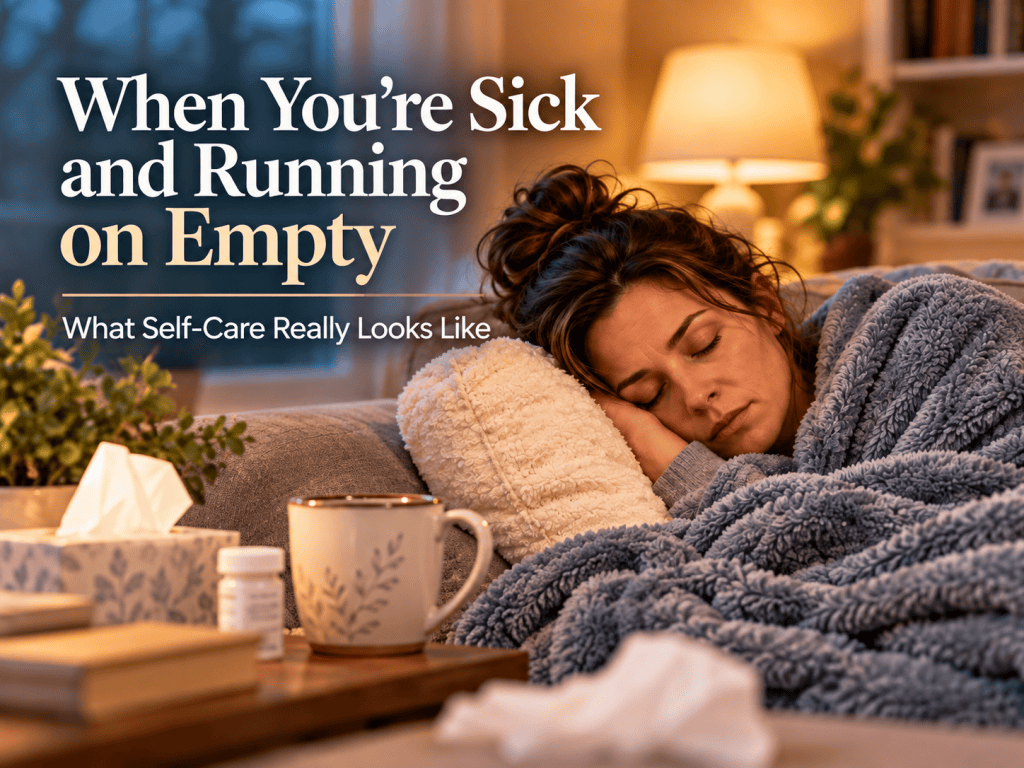
There is tired.
And then there is tired.
Last week, I was existing on less than six hours of sleep a night for more than a week.
Not functioning well. Not thriving. Not “pushing through.”
Existing.
Then I got sick.
Maybe my immune system had been taking a hit from the lack of sleep. Maybe I would have gotten sick regardless. I cannot prove which one was true, and I do not think pretending certainty would help anyone.
What I do know is that by the time illness landed on top of the sleep deprivation, my body had very little left to give.
I was crashing.
I felt it physically.
I felt it emotionally.
I felt it in my mental health.
I was nowhere near okay.
And at some point, the usual idea of simply carrying on was no longer realistic.
I had to listen to my body.
More importantly, I had to assertively state that my ability to get rest had to be honored.
That was not optional anymore.
When Rest Stops Being a Preference
There are times when rest is something we would like to get.
And then there are times when your body makes it very clear that rest has become a requirement.
That distinction matters.
When I reached that point last week, I could not treat sleep like the thing I would squeeze in after everything else was handled.
My body was already telling me what the consequences looked like.
Exhaustion.
Emotional fragility.
Physical illness.
Mental overload.
I could feel the cumulative effect of too many days running on too little sleep.
That meant something had to change.
Not someday.
Right then.
For me, self-care in that moment meant being clear with the people around me that I needed uninterrupted rest and that this need had to be respected.
That can feel uncomfortable.
Many of us are much better at accommodating everyone else than we are at saying:
I need this.
But sometimes self-care is not quiet.
Sometimes it requires a boundary.
Self-Care Is Not Always the Pretty Version
We have turned self-care into an aesthetic.
Candles. Baths. Skin care. Journaling. Exercise. Beautiful meals. A perfectly made bed and a cup of tea photographed beside it.
There is nothing wrong with any of those things.
But sometimes genuine self-care looks much less photogenic.
It looks like taking your medication and going back to bed.
It looks like eating something easy because cooking is simply not happening.
It looks like leaving the laundry where it is.
It looks like washing your face with the absolute minimum number of steps.
It may mean canceling something you genuinely wanted to do.
And sometimes it means telling the people around you, very clearly, that you need to be allowed to rest.
Sometimes self-care is recognizing that today’s available energy does not match today’s original plan.
That is not laziness.
It is information.
The National Institute of Mental Health describes self-care as taking time to do things that support both physical and mental health. It also notes that self-care looks different for everyone and that even small acts can make a meaningful difference.
That matters on the days when “small” is genuinely all you have.
Illness Plus Poor Sleep Changes the Equation
Sleep isn’t simply an empty period between one day and the next. It plays an important role in physical and mental functioning.
According to the Centers for Disease Control and Prevention, most adults need at least seven hours of sleep each night. The CDC also notes that sleep helps the body repair itself and that getting enough good-quality sleep helps us function normally during the day.
That matters even more when your body is already dealing with illness.
You may already be using more energy than usual just to get through the day. Add several nights of broken or inadequate sleep and suddenly you are working from a much smaller reserve.
That was exactly what I felt.
I did not suddenly become incapable.
I had simply exceeded what my body could continue carrying without recovery.
This is where The Current Theory becomes useful.
If you normally think of your baseline as the amount of energy and function available to you on an ordinary day, illness can temporarily move that baseline.
Poor sleep can push it farther.
Trying to continue operating as though nothing has changed does not magically restore the missing energy.
It simply means you’re budgeting from an account that doesn’t contain the money.
And unfortunately, our bodies do not offer overdraft protection.
Ask a Different Question
On a normal day, you might ask:
What do I need to get done today?
On a severely depleted day, that may be the wrong question.
Try:
What actually needs me today?
Those are not the same thing.
The first question can produce a list.
The second produces priorities.
Maybe you need to take your medication.
Maybe the dog needs to be fed.
Maybe you need to eat something with enough substance to keep yourself going.
Maybe there is one work responsibility that genuinely cannot wait.
Everything else deserves another look.
The National Institutes of Health Emotional Wellness Toolkit specifically recommends setting priorities when you’re under stress: decide what must get done and what can wait. It also recommends saying no to additional tasks when you’re taking on too much and asking for help when you need it.
That becomes especially important when your resources are temporarily limited.
This is not permission to stop caring about your responsibilities.
It is permission to recognize that not every responsibility has the same urgency.
The Minimum-Viable Day
Sometimes I think we need a category called the minimum-viable day.
Not every day needs to be optimized.
Not every day needs productivity.
Some days simply need to get you safely and reasonably comfortably from morning to bedtime.
On those days, self-care might mean:
- fluids nearby so you don’t have to keep getting up
- simple food requiring almost no preparation
- medications taken on schedule
- clean clothes, even if they aren’t the clothes you originally planned to wear
- sitting instead of standing whenever possible
- postponing nonessential errands
- accepting help when someone offers it
- lowering the standard for household tasks
- protecting your sleep
- going to bed embarrassingly early if that is what your body is asking for
And yes, sometimes watching television under a blanket instead of doing something “productive” is exactly what the situation calls for.
The house will survive.
I checked.
Make Things Easier Before You Need Them
One thing chronic illness has taught me is that convenience becomes much more valuable when your energy disappears.
When you feel reasonably well, small preparations can make bad days easier.
Keep medications organized.
Have a few foods available that require very little effort.
Keep important medical information in one place.
Know what symptoms are normal for you and which ones are not.
Keep comfortable clothing accessible.
Let the people closest to you know what genuine exhaustion looks like for you.
This is also where understanding your personal baseline matters.
If you know what your usual energy, sleep, pain, concentration and physical function look like, it becomes easier to recognize when something has meaningfully changed.
Read: Your “New Normal” May Not Be Fixed: What Baseline Really Means With Chronic Illness
And if your energy regularly changes throughout the day, planning around those patterns can reduce the amount of unnecessary fighting you do with your own body.
Read: The Current Theory — Why Your Energy Changes During the Day
Self-care becomes less about reacting to every difficult day and more about building a life that has a little room for them.
There Is an Emotional Side to Exhaustion Too
Physical exhaustion has a way of turning up the volume on everything else.
Minor frustrations feel larger.
Decisions feel harder.
You may become irritable, tearful or discouraged.
You may feel disconnected from yourself.
You may know intellectually that you are exhausted, but emotionally it can start to feel as though you are simply failing at being a person.
That is where I was.
The lack of sleep and illness were not only affecting my body.
They were affecting the way I was coping.
My patience was thinner.
My emotional resilience was lower.
My mental health was taking the hit right along with everything else.
The NIH Emotional Wellness Toolkit notes that emotional wellness affects how we handle everyday activities, relationships, stress and difficult periods. It also specifically lists inadequate sleep, low energy and difficulty coping among the things worth paying attention to.
And that is one of the most important things I learned from that week:
You cannot always think your way out of a body that is profoundly depleted.
Sometimes the intervention is sleep.
Not motivation.
Not discipline.
Not a better planner.
Sleep.
And when your need for rest is beginning to affect your physical health, emotional stability and ability to function, it may be time to stop treating rest as negotiable.
You may need to say it clearly:
I need to sleep. I need uninterrupted rest. This has to be respected.
That is not selfish.
That is taking your condition seriously.
What Happened When I Actually Slowed Down
After several nights of real sleep and a couple of days moving at a much slower pace, I began to feel the difference.
I had three consecutive nights of about eight and a half to nine hours of sleep.
I stopped expecting myself to move at my normal pace.
I prepared lunches ahead of time for the next few days.
I made sure the next dinner required nothing more than reheating.
In other words, I removed decisions and work wherever I could.
I wasn’t organizing my pantry.
I wasn’t catching up on everything I had fallen behind on.
I wasn’t using the first little burst of returning energy as evidence that I should immediately resume doing all the things.
I was recovering.
After more than two days of deliberately taking care of myself, I finally began moving back toward my normal everyday baseline.
I was not suddenly overflowing with energy.
I just almost felt like myself again.
I would say I was about 90% back.
And honestly, that was enough evidence for me that slowing down had been exactly what my body needed.
The goal was not to become productive again as quickly as possible.
The goal was to recover.
Those are not the same thing.
The Word “Should” Gets Dangerous When You’re Depleted
When you’re exhausted, you may start thinking about all the things you should be doing.
I should clean this.
I should answer that.
I should be able to handle this.
I should be doing more.
I should not need this much rest.
That word can become particularly cruel when you’re already depleted.
Sometimes the most compassionate thing you can do is replace should with a more useful question:
What would help me recover?
That answer may not resemble your normal routine.
That’s the point.
Self-care should respond to the version of you who exists today, not the version of you who existed last Tuesday.
The National Institute of Mental Health also recommends setting goals and priorities, deciding what needs to happen now and what can wait, and learning to say no when you are taking on too much.
Sometimes reducing the load is not avoiding self-care.
It is self-care.
Rest Is Not the Same as Giving Up
There is an important difference between withdrawing from life and recognizing that your body needs recovery.
Rest can be active care.
Reducing demands can be care.
Asking someone else to handle dinner can be care.
Saying, “I cannot do that today,” can be care.
Protecting your sleep can be care.
And when you live with a chronic condition, sometimes the hardest part is learning not to turn a temporary loss of capacity into a judgment about yourself.
One bad day does not define your health.
One exhausting week does not erase the progress you have made.
And needing more support during illness does not automatically mean your normal baseline is gone forever.
It means something has changed right now.
The Current Theory is built around noticing exactly that.
What is normal for me?
What has changed?
How much has it changed?
What does my body need in response?
When something feels significantly different from your normal pattern, particularly severe or persistent fatigue or major changes in sleep, mood or ability to function, that information is worth discussing with your healthcare provider.
NIMH recommends seeking professional help when significant or distressing symptoms persist or begin interfering with your usual activities. You can read its guidance on Caring for Your Mental Health here.
Sometimes Self-Care Is Simply Making Today Smaller
There are days when self-care can be aspirational.
You can exercise.
Cook something wonderful.
Organize your life.
Go for a walk.
Spend time doing something you love.
And then there are the days when self-care has a much simpler job.
Keep you fed.
Keep you hydrated.
Keep you comfortable.
Take your medicine.
Protect whatever energy you have left.
Protect your sleep.
Let your body recover.
And when necessary, make it clear that your need for rest is not something that can simply be pushed aside.
Tomorrow can have tomorrow’s expectations.
Today only needs today’s.
And sometimes, that is more than enough.
Sources and Further Reading
Centers for Disease Control and Prevention: About Sleep and Your Heart Health
National Institutes of Health: Emotional Wellness Toolkit
National Institute of Mental Health: Caring for Your Mental Health
Medical note: This article is for educational purposes and is not a substitute for medical advice. New, severe, persistent or unexplained fatigue, major sleep changes, significant mood changes or other concerning symptoms should be discussed with an appropriate healthcare professional.


Leave a comment