
A friend said something to me recently that stuck with me.
She is 75 and dealing with new medical diagnoses. She told me she is learning to live with them.
But she is not ready to slow down.
I understood exactly what she meant.
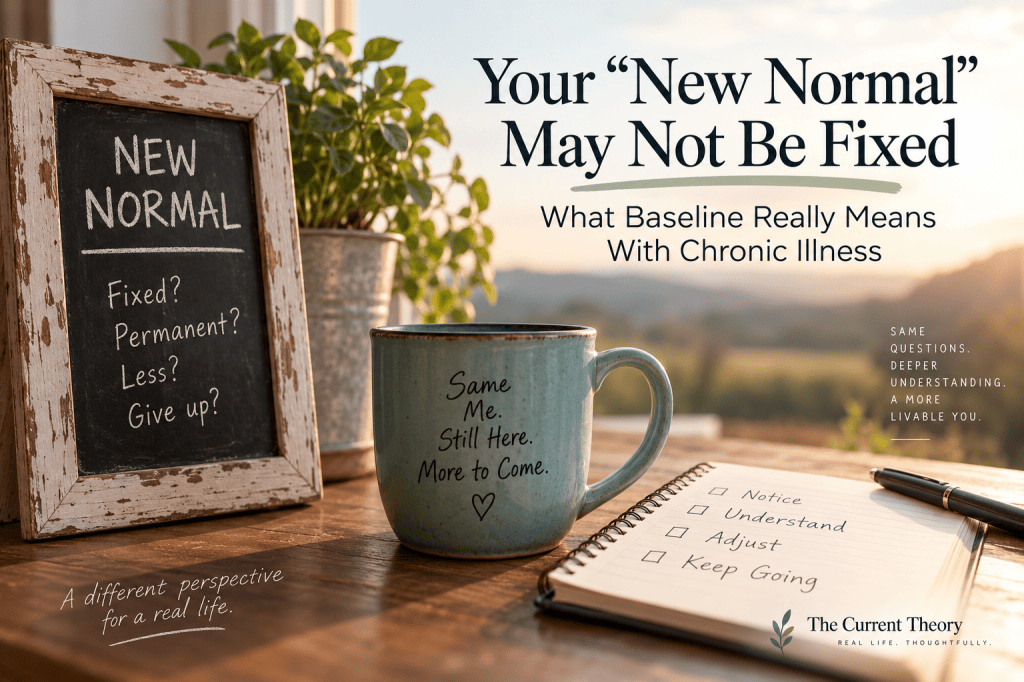
“Learning to live with it” is a phrase people with chronic illness hear all the time. So is “finding your new normal.” Sometimes those words are helpful. A diagnosis can change routines, abilities, priorities and expectations. There really can be some adjustment involved.
But I think there is a problem hiding inside the phrase new normal.
It sounds settled.
Permanent.
As though there was the life you had before, something happened, and now you have arrived at the life you will have from this point forward.
For many people living with chronic illness, it simply isn’t that tidy.
Some conditions fluctuate. Symptoms change. Energy changes. Treatment changes things. Life changes things. There may be stretches when you function fairly well and others when the same things require much more effort.
So maybe the question isn’t always:
What is my new normal?
Maybe sometimes the better question is:
What is my current baseline?
And what does baseline actually mean?
Before We Go Any Further
The Current Theory is a framework for understanding your own patterns, capacity and experience of living with chronic illness. It is not a diagnostic tool, and nothing in this article is intended to diagnose, treat or determine the progression of any medical condition.
I am not a medical professional, and I cannot tell you what your baseline is or what a change in your baseline may mean medically. The purpose of this article is to help you think about your own patterns so you can better understand and describe your experience.
Nothing here should replace appropriate medical care or the guidance of a qualified healthcare professional. If you notice new, worsening, persistent or concerning symptoms, discuss them with your healthcare provider.
If you are experiencing a medical emergency or symptoms that may require urgent attention, seek immediate medical care or call emergency services.
So What Does “Baseline” Actually Mean?
The word baseline sounds very medical and very precise.
Sometimes it is.
In clinical research, the National Institute on Aging defines baseline as the initial point at which measurements are taken so later measurements can be compared against them.
A blood test, physical assessment or other measurement might be recorded at baseline and then checked again later to see what changed.
But baseline is also used in a more personal way.
Mental health professionals, for example, may compare someone’s current mood, behavior, cognition or level of functioning with that person’s usual state.
Sometimes you are the comparison point.
How do you normally function?
What is typical for you?
What can you usually manage?
What feels noticeably different?
That gets harder when chronic illness is involved.
Because what happens when usual keeps moving?
Maybe Baseline Is a Range, Not a Number
I think baseline makes more sense as a range.
Within The Current Theory, this is the definition I am working with:
Your current baseline is the general range of function and activity that seems reasonably sustainable for you, taking into account the normal recovery that life requires.
The word current is intentional.
Your baseline describes what appears true under your present circumstances. It is not a prediction of what you will be capable of six months from now, next year or for the rest of your life.
And I use the word range because most people do not function at precisely the same level every day.
You can sleep badly.
Have a stressful week.
Catch a cold.
Work too hard.
Spend the day with grandchildren.
Paint a cabinet.
Life has opinions.
And then there is reasonably sustainable.
The maximum amount you can force yourself to accomplish is not necessarily your baseline.
Being Able to Do Something Once Doesn’t Tell the Whole Story
There is a difference between being able to complete something and being able to reasonably sustain that level of activity.
You may think:
But I did it yesterday.
You did.
That tells you that you were capable of doing it yesterday.
It does not necessarily tell you what that activity cost you, whether you can repeat it, or whether it represents your usual level of function.
Pacing guidance for some chronic conditions already recognizes this idea. In ME/CFS, for example, the CDC advises people to identify their own physical and mental activity limits because going beyond those limits can cause delayed worsening of symptoms.
That does not mean every person with chronic illness has ME/CFS or experiences post-exertional malaise. Different illnesses behave differently.
But it does show why simply finishing an activity may not tell the whole story.
You may be able to do something.
The bigger question may be whether you can reasonably keep doing it.
Normal Recovery Is Still Normal
We also need to leave room for ordinary life.
Yesterday, I sat on a hard laminate floor for quite a while and painted a cabinet.
Today my lower back and the bones in my rear end are a little sore.
There is no great mystery here.
I sat on a hard floor painting a cabinet.
It would probably be smart today not to spend another several hours putting pressure on those same areas. That would be a reasonable decision whether someone has a chronic illness or not.
It does not automatically mean my baseline changed.
It means my butt has filed a formal complaint about yesterday’s working conditions.
Human beings need recovery.
Healthy people get sore after physical work. They get tired after long days. They need sleep after travel. They sometimes do too much and feel it the next morning.
Understanding your baseline should not mean watching every ache, tired afternoon or recovery day and turning ordinary life into a medical event.
Normal recovery still gets to be normal.
One Bad Day Doesn’t Automatically Become a New Baseline
Suppose today is awful.
You have less energy. Everything takes longer. Your symptoms are louder. You accomplish half of what you normally would.
That tells you something about today.
It does not automatically tell you what next month will look like.
Maybe you are having a flare.
Maybe you slept terribly.
Maybe you overdid something yesterday.
Maybe you are coming down with something.
Maybe something has changed medically.
Or maybe today is simply one bad day.
One difficult day is one piece of information.
Patterns tell you more.
If activities you ordinarily managed are repeatedly harder, your recovery consistently takes longer, or the range of activity you can reasonably sustain seems different over time, you may begin wondering whether your baseline itself has changed.
That is very different from declaring a new baseline after one rotten Tuesday.
Has My Baseline Changed, or Is My Disease Progressing?
This is where the question can become scary.
The Current Theory can help you notice and describe changes in your own patterns, but it cannot determine what those changes mean medically.
If you notice that you are functioning differently, it is easy for your mind to jump to:
Is my disease getting worse?
A change in how you function does not, by itself, tell you what is happening medically.
Different chronic illnesses behave differently. Symptoms can worsen temporarily for many reasons. Some conditions involve flares. Some are progressive. Some remain relatively stable for long periods. Some improve with treatment or changes in circumstances.
And symptoms that seem related to an existing diagnosis can sometimes have another explanation entirely.
The Current Theory can help you say:
“Something about my usual pattern has changed.”
It cannot tell you:
“My disease has progressed.”
That is a medical question.
If you are noticing a persistent, unexplained or concerning change from your usual function or symptoms, that information may be worth documenting and discussing with your healthcare provider.
Knowing your own patterns may also make those conversations easier.
Instead of only saying:
I just don’t feel right lately,
you may be able to explain what changed, when you noticed it, what you used to manage, what feels harder now and how recovery has changed.
That is useful information.
It is not a diagnosis.
“Learning to Live With It” Doesn’t Have to Mean Giving Up
This takes me back to my friend.
She is learning how to live with new diagnoses.
She is also 75 years old and not particularly interested in receiving a memo that says her active life is now over.
Those two things can coexist.
Medical resources often talk about adapting to a “new normal” after a chronic diagnosis.
And yes, there can be real value in accepting what is true.
If your body cannot sustainably do something today, pretending otherwise does not change that.
But accepting what is true today is not the same as deciding what will always be true.
You can make accommodations without assuming they are permanent.
You can slow down when your body needs it without deciding that you must always move slowly.
You can recognize a limitation without making it your identity.
You can learn to live with a diagnosis and still want more life.
That is not the same thing as denial.
It is simply leaving room for change.
Your current baseline tells you something about where you are.
It does not necessarily tell you where you are going.
How Do You Begin Thinking About Your Own Baseline?
You do not need to calculate it to three decimal places.
You are looking for patterns.
You might ask yourself:
- What does an ordinary day look like for me right now?
- What activities can I usually manage and repeat without an unusually large recovery cost?
- What normally requires recovery, and what does that recovery usually look like?
- Which symptoms fluctuate regularly for me?
- What activities consistently cost me more than I expect?
- Is there a difference between what I can make myself do and what I can reasonably sustain?
- Have any of those patterns noticeably changed?
- Am I comparing myself with my actual life today, or with the person I was before I became ill?
- Am I using my best day as evidence of what I should be able to do every day?
- Am I using my worst day as evidence of what I will always be able to do?
There may not be a perfect answer.
You are not trying to place yourself into a smaller box.
You are trying to understand the shape of the life you are actually living well enough to make better decisions inside it.
Your Baseline Is a Reference Point, Not a Verdict
I think baseline becomes much more useful when we stop treating it as another name for a permanent “new normal.”
A baseline gives you something to compare against.
It can help you notice when your current is running differently.
It can help you see patterns.
It may help you explain changes more clearly to the people involved in your care.
And it can help separate one hard day from the bigger picture.
But it should never become a sentence handed down about the rest of your life.
Your current baseline is the general range of function and activity that seems reasonably sustainable for you, taking into account the normal recovery that life requires.
That is all it has to be.
A description of what seems true now.
Not your best day.
Not your worst day.
Not who you used to be.
And not a prediction of who you will become.
Just a better understanding of where you are today.
Want to explore your own patterns more closely? Visit The Current Theory hub to read the framework, glossary, and related resources.
Sources Referenced
- National Institute on Aging, glossary of clinical research terms
- American Psychiatric Association, psychiatric evaluation and baseline functioning
- MedlinePlus, living with chronic illness and adapting to change
- Centers for Disease Control and Prevention, ME/CFS activity management and post-exertional malaise guidance
 Life Made Simple
Leave a comment