
Doctor appointments can feel surprisingly rushed—even when you’ve been waiting weeks or months for the visit.
You may walk in knowing exactly what you want to discuss, only to find yourself trying to remember symptoms, medication changes, test results, questions you meant to ask, and what another specialist told you three months ago.
Then the appointment ends, and the question you really wanted to ask comes back to you somewhere between the exam room and the parking lot.
A little preparation can make a big difference.
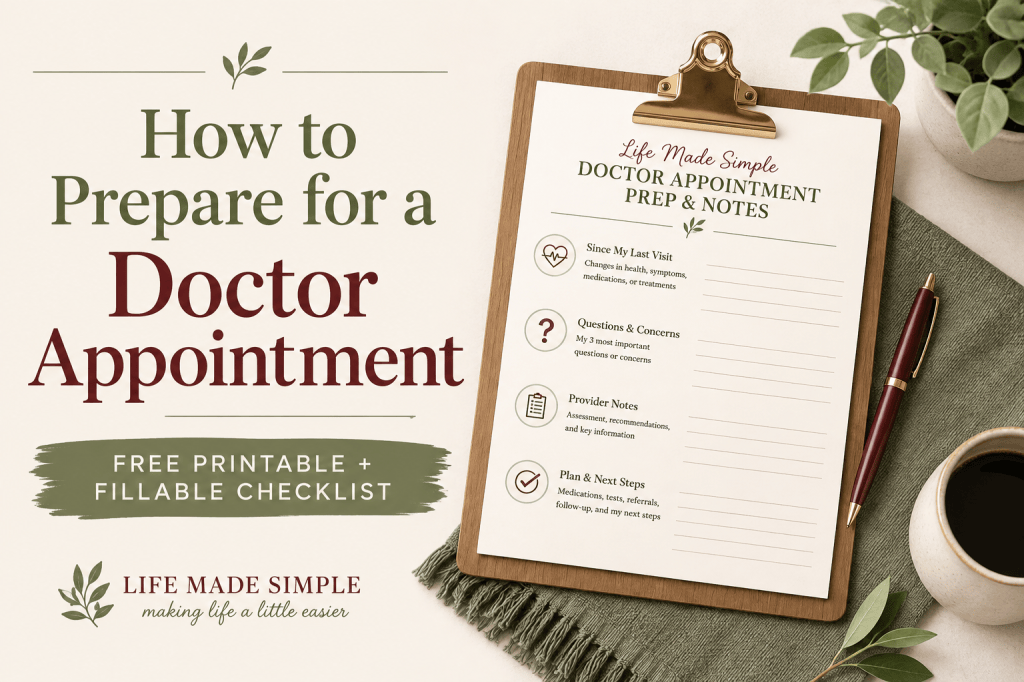
I created the Life Made Simple Doctor Appointment Prep & Notes sheet to help you organize the important information before your appointment, stay focused during the conversation, and leave with a clearer understanding of what happens next.
Why Doctor Appointments Can Feel So Scattered
Healthcare visits require you to process a lot of information in a relatively short amount of time. At the same time, your provider is trying to understand what has changed, address your concerns, review medications and test results, make decisions, and determine the next steps.
This can become even more complicated when several healthcare providers are involved in your care.
Maybe a specialist started a medication. Another provider changed the dose. You had a test performed somewhere else. You visited urgent care between appointments. Or you received a new diagnosis that your other providers may not yet know about.
Keeping those details straight shouldn’t depend entirely on memory.
The goal of preparing for an appointment isn’t to control every minute of the visit. It’s to make sure the information and questions that matter most don’t get lost in everything else happening during that limited time.
What Changed Since Your Last Visit?
One of the easiest things to overlook during a medical appointment is everything that has happened between visits.
If you see more than one healthcare provider, this becomes especially important. A specialist may have started a new medication, stopped another one, changed a dose, ordered testing, or recommended a new treatment. Your primary care provider—or even another specialist—may not have all of those details in front of them during your appointment.
Before your visit, take a few minutes to think about what has changed since you last saw this particular provider.
Consider noting:
- New or worsening symptoms
- New diagnoses
- Important test or lab results
- Emergency room, urgent care, or hospital visits
- Procedures or treatments
- New medications
- Medications that were stopped
- Dosage changes
- Who made each medication or treatment change and why
- Side effects or other changes you’ve noticed since starting or changing a treatment
You don’t need to reconstruct your entire medical history. The goal is to give your provider a clear picture of what is different now compared with the last time they saw you.
Why medication changes deserve special attention
A current medication list tells a provider what you’re taking, but it doesn’t always explain what changed or why.
For example, knowing that another specialist reduced a medication because of a side effect provides much more useful context than simply seeing the new dose on a medication list.
That’s why the Doctor Appointment Prep & Notes sheet includes a dedicated place to record the medication or treatment, what changed, which provider made the change, and the reason for it.
Choose Your Priorities Before You Walk In
It’s tempting to arrive at an appointment with a mental list of everything you want to discuss. The problem is that mental lists have a way of disappearing once the conversation starts.
Before your appointment, decide which concerns are most important to you.
Write down your top three questions or concerns, and put the most important one first. If there is something you absolutely need to address during the visit, don’t save it until the end.
This doesn’t mean your other concerns aren’t important. It simply helps you use the time you have more intentionally and makes it less likely that your main reason for scheduling the appointment gets lost in the conversation.
Be specific about what you want help with
Instead of writing something broad like “fatigue,” give yourself a few details that will help you explain what’s happening:
When did it start? Has it changed? What makes it better or worse? How is it affecting your everyday life?
You don’t need to diagnose yourself or arrive with a perfectly organized medical presentation. A few concrete details can simply make it easier to communicate what you’re experiencing.
During the Appointment: Capture What Matters
Once the appointment begins, you don’t need to spend the entire visit trying to take perfect notes. The goal is to capture the information you’ll need later.
Pay particular attention to decisions that affect what happens after you leave. If your provider recommends a new medication, test, referral, or treatment, write it down while the information is fresh.
If something isn’t clear, ask for clarification. It is completely reasonable to ask questions such as:
- What do you think may be causing this?
- What are we trying to learn from this test?
- What should I expect from this treatment?
- Are there side effects or problems I should watch for?
- When and how will I receive my test results?
- When should I follow up?
You may also want to repeat important instructions back in your own words. A simple, “So just to make sure I understand…” can help clarify the plan before you leave.
Don’t rely on memory for the next steps
The end of an appointment can sometimes move quickly: a prescription is sent, a referral is placed, labs are ordered, and you’re headed toward the checkout desk.
Before that happens, make sure you know what you’re responsible for doing next and what the healthcare team will handle.
If you’re supposed to schedule a test, wait for a referral call, change a medication, return in three months, or contact the office if something doesn’t improve, write it down.
Before You Leave: Make Sure You Know What Happens Next
Before the appointment ends, take a moment to make sure you understand the plan.
You should leave knowing what happens next—not wondering later whether you were supposed to schedule something, wait for a phone call, change a medication, or return for follow-up.
Before you leave, try to answer these questions:
- Were any medications or treatments changed?
- Were labs, imaging, or other tests ordered?
- Was a referral placed?
- Do I need to schedule anything myself?
- When should I expect results?
- When should I follow up?
- What symptoms or changes should prompt me to call the office?
- Is there anything that would require more urgent medical attention?
If you aren’t sure about something, ask. Clarifying the plan while you’re still there can save a lot of confusion once you’re home.
Give yourself one place to keep the answers
Scraps of paper, patient portal messages, appointment summaries, and mental notes can quickly become difficult to keep straight.
Having one simple page for each appointment gives you a place to record what changed, what you wanted to discuss, what your provider recommended, and what you’re supposed to do next.
That’s exactly why I created the Life Made Simple Doctor Appointment Prep & Notes sheet.
Free Doctor Appointment Prep & Notes Worksheet
To make this process easier, I created the Life Made Simple Doctor Appointment Prep & Notes worksheet—a simple one-page tool you can use before, during, and after your medical appointments.
It gives you one place to organize:
- What has changed since your last visit
- Medication or treatment changes made by another provider—and why
- Your three most important questions or concerns
- Notes from your provider’s assessment or recommendations
- Medication or treatment changes made during the appointment
- Labs, tests, referrals, and follow-up plans
- Symptoms or changes you should watch for
- Your next steps
The free download includes two versions: a printable PDF you can write on by hand and a fillable PDF you can complete digitally.
Free download • Printable + fillable PDF • For personal use
Build a Simple System for Managing Your Health Information
Preparing for appointments is only one part of keeping your health information organized.
Ideally, you want a simple system that helps you quickly answer three different questions:
What would someone need to know about me in an emergency?
Keep your essential medical information together with the Emergency Medical Snapshot.
What do I need for this appointment?
Use the Doctor Appointment Prep & Notes sheet to organize recent changes, questions, decisions, and next steps.
Where do I keep the bigger picture?
Use your Medical Binder to organize the health information and records you may need over time.
You don’t need a complicated system. You just need to know where your information is when you need it.
A Little Preparation Can Make Appointments Easier
Medical appointments may still feel busy, and you may not get to every question every time. But walking in prepared can help you spend less energy trying to remember everything and more time having the conversation you came to have.
Write down what changed. Decide what matters most. Take notes about the plan. And before you leave, make sure you know what happens next.
Sometimes making healthcare feel a little more manageable starts with something as simple as having the right information in front of you.
Ready for your next appointment? Get your free Doctor Appointment Prep & Notes worksheet →
Medical Disclaimer: The information provided by Life Made Simple is for educational and organizational purposes only and is not intended to replace professional medical advice, diagnosis, or treatment. Always consult a qualified healthcare professional with questions about your health, medications, symptoms, or treatment. Never disregard or delay seeking professional medical advice because of information you have read on this website.
 Life Made Simple
Leave a comment